«I will utterly sweep away everything from the face
of the earth," declares the Lord. "I will sweep away
man and beast; I will sweep away the birds of the
heavens and the fish of the sea,and the rubble with
the wicked. I will cut off mankind from the face of
the earth," declares the Lord» (Zephaniah 1:2, 3)
«For then there will be great tribulation, such as has
not been from the beginning of the world until now,
no, and never will be. And if those days had not been
cut short, no human being would be saved. But for
the sake of the elect those days will be cut short»
(Matthew 24:21, 22)
1. The predictions of the End
The theme of the end of the world and the collapse of technological civilization has occupied the pages of books, magazines, and newspapers for many years, as well as cinema and television screens, and today the countless forums and websites of the Internet. Over the past centuries, astrologers, clairvoyants, scientists, and believers have predicted numerous dates for the destruction of humankind.
Among the most well-known dates were: 1833 and 1844, 1900, 1914, 1943, 1988, 1999–2001, and 2012. The subject of humanity’s destruction became especially popular during the twentieth century — the most militarized century in history — in which two world wars took place, atomic and hydrogen bombs were invented, and nuclear weapons of mass destruction were created.
Obviously, these circumstances, together with the approaching turn of the millennium, gave rise to countless predictions that the end would supposedly come in the year 2000 (or, according to another version, in 2001). Others pointed to August 1999, when, according to the prophecy of the medieval physician and astrologer Nostradamus, "the great King of Terror shall descend from the sky..." Yet once again, none of these predictions came true, which hardly troubled the visionaries themselves, who simply began announcing new dates.
In the twenty-first century, there has hardly been a single year for which someone had not predicted, several years in advance, a global catastrophe that would either completely destroy intelligent life or drastically reduce the number of its representatives. Thus, June 21, 2008, and May 21, 2011, passed without incident, although the California preacher Harold Camping had proclaimed the latter date to be the end of the world — for the third time.
Likewise, nothing catastrophic occurred on December 21, 2012, despite widespread predictions that the Earth would collide with the invisible planet Nibiru, that the era of the Fifth Sun in the Mayan calendar would end, that a great planetary alignment (supposedly occurring once every 226,000 years) would take place, or that the magnetic poles would reverse. According to various sources, from 2000 to 2020 no fewer than twelve (!) such "apocalyptic spectacles" were expected.
Believing false prophets, some people live in constant fear, expecting the end at any moment. Others even hide in underground shelters for extended periods, as happened in Russia in 2008 in the village of Nikolskoye (the so-called “Penza recluses”).
One may laugh at such absurd fears, or dismiss any sense of approaching tragedy — but perhaps it is wiser to reflect seriously. It is more reasonable to consider three eschatological questions:
- Will the end of the world occur in the coming years?
- If it does, how will it happen?
- And if it will happen, then when?
Let us attempt to answer these questions, whose relevance increases as humanity approaches an epochal event.
2. Will There Be an End of the World?
To this question, “specialists” in predicting the future — from amateurs to professionals — answer in unison: "Yes." After that, each visionary vividly paints his own scenario of dramatic events and catastrophic consequences for the world.
These range from fantastical plots involving the decay of a metastable vacuum, an alien invasion, or the appearance of a black hole; to less probable scenarios such as a shift in the Earth’s center of gravity, the overturning of the planet, reversal of the magnetic poles, total destruction of the ozone layer, gigantic solar prominences, the Earth entering the gravitational field of a neutron star or a поток of intense gamma radiation, a failed scientific experiment, and so forth. Others, however, point to more plausible dangers — for example, the eruption of several supervolcano calderas, a thermonuclear or biological world war, a pandemic, or the exhaustion of natural resources.
Strangely enough, many scientists also give an affirmative answer to the same question: "Will there be an end of the world?" Analyzing the current trends of a society of excessive consumption, lacking harmony and balance, specialists arrive at a disturbing conclusion. In the coming decades, humanity may perish as a result of an ecological catastrophe caused by the negative consequences of human activity:
- pollution of the environment (fresh and marine waters, soil, and air) by toxic industrial waste and untreated sewage;
- destruction of the ozone layer in the atmosphere, which protects all living beings from the harmful ultraviolet radiation of the Sun;
- emissions of carbon dioxide and methane, leading to an increase in tropospheric temperatures (the so-called "greenhouse effect"), causing the melting of polar ice, disruptions of established atmospheric circulation and ocean currents, and other irreversible adverse phenomena;
- extermination of key biological taxa within the environment, resulting in ecological degradation.
The danger of such negative changes can be compared to the threat of a global thermonuclear war. Since the beginning of the twenty-first century, climatologists have warned that «within three or four decades, climate change may destroy ecological systems vital to humanity.» Researchers from the World Wildlife Fund assume that the planet’s main biological resources could be exhausted by 2030, while another scenario — called "Business as Usual" — predicts ecological collapse by the year 2050.
Other scientists, supporters of the Theory of Catastrophes in Earth’s geological history (proposed by Cuvier in 1812), are convinced that humanity will not perish gradually because of worsening environmental conditions, depletion of natural resources, famine, or epidemics, but will instead be destroyed very rapidly as the result of another large-scale cataclysm.
Biologists claim that there have already been seven episodes of mass extinction in which from 10% to 50% of plant and animal species disappeared; moreover, there were three particularly devastating events (250 million, 220 million, and 65 million years ago) during which between 70% and 95% of all flora and fauna perished.
Some researchers see the cause of a future collapse of civilization in cosmic global events: collisions with large celestial bodies or nearby gamma-ray bursts from stars. Others point to supervolcanic eruptions, global glaciation, sudden shifts of the geographic poles, massive solar coronal ejections, and similar phenomena.
Still others expect man-made global catastrophes: worldwide thermonuclear war, an alien attack, the destruction of life by artificial intelligence, a failed physical or biological experiment, deliberate destruction of the ozone layer, or runaway global warming.
Skeptics, though not scientists, yet possessing a philosophical cast of mind, reasonably observe: «If the world had a beginning, then it will also have an end.»
3. How Will It All Happen?
If we set aside fantastical and highly improbable versions of the end of the world, then one of the most realistic scenarios is an "impact event" – a collision of the Earth with a comet or a massive asteroid (Fig. 1).
In the «Classification of Natural Emergency Events» of the Russian Academy of Sciences, this type of cosmic impact catastrophe occupies the first place among global natural threats.
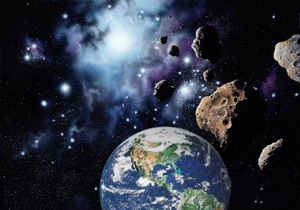
American scientists reached a similar conclusion as early as 1998, prompting the U.S. government to establish within NASA the NEOPO group to study the danger of asteroid bombardment of our planet by objects at least 1 km in diameter.
Today, more than 385,000 celestial rocks have received official catalog numbers, and 18,000 of them have also been given names.
Using modern equipment and instruments, the NEOPO group not only discovers and tracks so-called «near-Earth asteroids» (of which there are about 2,000), but also coordinates their observation programs and determines their flight trajectories.
At present, there are numerous projects within the framework of the “Spaceguard” program, the most well-known being “LINEAR,” with some projects funded by NASA. The online database of all known near-Earth objects is called “NEODyS.”
Astrophysicists argue that our fragile technological civilization could be destroyed by the impact of a planetoid with an equivalent diameter of 3 to 5 kilometers. A similar event involving a minor planet more than 10 kilometers in diameter would lead to mass death and extinction of living organisms. For this reason, a number of resolutions and declarations were adopted already in the twentieth century, including by the Parliamentary Assembly of the Council of Europe: "On the Detection of Asteroids and Comets Potentially Dangerous to Humankind" (Resolution No. 1080 of 1996).
Only in the recent past has our world been struck by cosmic bombardments on three occasions. In 1908, the Tunguska meteoroid exploded at an altitude of about 18 km, with an estimated energy release of E = 10 ... 20 megatons of TNT (the energy released by the detonation of trinitrotoluene). In 1930, another explosion occurred in the Amazon River basin (E = 1 Mt TNT). In 1947, the Sikhote-Alin iron meteorite, with an initial mass of about 70 tons, fragmented in the atmosphere and fell into the Ussuri taiga.
On February 15, 2013, near the city of Chelyabinsk in Russia, a bolide with an initial mass of up to 13,000 tons and a diameter of about 17 meters exploded at an altitude of 15 ... 25 km (E = 0.5 Mt TNT). Among the most heavily affected sites was the Chelyabinsk Zinc Plant. A meteorite shower fell over approximately 500 populated areas, and up to 1,200 people were injured, although no fatalities occurred.
Throughout its existence, the Earth has experienced more than a million impacts from crater-forming bodies, including several thousand objects up to 1 km in diameter and dozens of minor planets, each with an equivalent diameter exceeding 10 km. During the last 6,000 years alone, Earth has endured around 30 natural catastrophes caused by impacts of cosmic objects.
Nevertheless, even at the end of the eighteenth century, members of the Paris Academy of Sciences declared that «the fall of stones from the sky is physically impossible.» Moreover, the idea of the extraterrestrial origin of meteorites was regarded as false by the international scientific community until the beginning of the nineteenth century, while the theory of impact crater formation remained little more than a hypothesis until the 1960s.
The first dwarf planet, Ceres, was discovered by the astronomer Giuseppe Piazzi in 1801. Yet until 1980, the scientific community did not seriously discuss the possibility that mass extinctions and changes of geological epochs on Earth could be caused by asteroid collisions.
4. Cosmic Catastrophe
The reality of collisions between our planet and cosmic bodies is confirmed by the presence on Earth’s surface of about 207 reliably identified and 238 probable impact craters ranging in diameter from 10 ... 30 meters up to 300 (!) kilometers (the Vredefort crater, South Africa, Free State Province). Every year, geologists discover from 2 to 5 new astroblemes (Greek: "star wound").
For example, the Arizona crater has a diameter of 1,230 m; the Chicxulub megacrater in Mexico measures 180 km; Sudbury in Ontario, Canada, 250 km; and Vredefort in South Africa, 300 km. In the third case, the consequences of the cosmic catastrophe affected an area of 1,660,000 km² of the Earth’s surface, while fragments of rock were scattered up to 800 km from the impact epicenter. It is also assumed that the Gulf of St. Lawrence (Canada) may be part of an enormous impact crater approximately 290 km in diameter.
A group of 41 scientists from Europe, the United States, Mexico, and Japan — including paleontologists, geochemists, geophysicists, and climate-modeling specialists — came to the conclusion that the Cretaceous–Paleogene mass extinction of organisms, including the dinosaurs, was caused by the collision of our planet with an asteroid traveling at a speed of about 50,000 km/h. Specifically, at the end of the Cretaceous period, 65.5 million years ago, a planetoid body or one of its fragments with a diameter of no less than 10 km fell into shallow waters near the Yucatán Peninsula (modern-day Mexico).
The energy of the explosion amounted to approximately 70×10⁶ megatons of TNT, or 2.93×10²³ joules, which is equivalent to the detonation of 70 million one-megaton nuclear bombs. The Chicxulub crater was formed, with a diameter of 180 km and an original depth of 20 km. Approximately 325 billion tons of sulfur oxides, 425 billion tons of carbon oxides, and 500 billion tons of mineral rock were ejected into the atmosphere. About 10% of the material escaped into space, while 90% returned to Earth in the form of incandescent fragments of rock, stones, sand, and dust.
A global earthquake, with a magnitude significantly exceeding 9 on the Richter scale, shook the entire planet. Worldwide fires destroyed approximately 90% of the Earth’s forests, releasing around 15 trillion tons of gases, soot, ash, and cinders into the atmosphere. An "asteroid winter" lasting several years followed, during which the average annual temperature dropped by 27°C.
As a result of the cataclysm, not only the dinosaurs – the most numerous superorder of reptiles – but also about 70% of all fauna and flora perished either immediately or over time. The process of photosynthesis was inhibited for up to two years, leading to the disappearance of phytoplankton in the World Ocean; the concentration of oxygen in the atmosphere also decreased.
According to specialists, a collision with an asteroid 30 km in diameter (according to other estimates, 60 km) would destroy ALL highly organized forms of life. Thus, there exists a scientific hypothesis concerning the fall of a giant planetoid that may have caused the great Permian–Triassic extinction, during which more than 95% (!) of all organisms disappeared 251.4 million years ago. Some scientists associate this megacatastrophe with the presence of an astrobleme approximately 500 km in diameter in Wilkes Land beneath the ice of Antarctica.
5. Thermonuclear Bombardment
The main destructive factors of an unprecedented impact event would be:
- a powerful thermal radiation pulse;
- an atmospheric shock wave generated by the explosion of the cosmic body at low altitude;
- an atmospheric plume — a column of hot dust, steam, and water;
- in the case of an asteroid striking land or sea — a shock wave in the Earth’s crust, its deformation, partial vaporization, melting, and fragmentation of matter;
- a global earthquake causing widespread seismic shaking;
- volcanic eruptions and supervolcanic explosions triggered by earthquakes;
- tsunamis, mega-tsunamis, and mega-runup waves;
- hypercanes, hurricanes, typhoons, and tornadoes;
- large-scale forest, steppe, and savanna fires;
- global darkening caused by dense worldwide ash fallout;
- hot acidic rains of red, black, and white coloration;
- extreme atmospheric heating followed by abrupt global cooling lasting several years.
Celestial bodies enter the homosphere at tremendous speed, while the noise generated during their flight may exceed 120 decibels. The cause of the gigantic explosion at the moment of impact is the conversion of kinetic energy into mechanical, thermal, and luminous energy (a blinding flash).
The total energy released during the formation of an astrobleme with a diameter ranging from 1 km to 200 km is estimated at between 10¹⁸ joules and 5 × 10²⁴ joules. In the latter case, this equals approximately 1.2 × 10⁹ megatons of TNT – which are more than 20 million times more powerful than the most powerful thermonuclear bomb. For comparison, the total annual seismic energy released across the entire planet amounts to approximately 10¹⁹ joules.
The asteroid Apophis, with a diameter of only 325 ± 15 meters, a mass of 2.7 × 10¹⁰ kg, and a velocity of 30.728 km/s, possesses approximately the same amount of kinetic energy (0.5 × 10¹⁹ joules) — about 50,000 times greater than the energy of the nuclear bomb dropped on Hiroshima (10¹⁴ joules). However, the probability of Apophis colliding with Earth is extremely low (1 in 1,000,000).
During an impact event, the compression wave creates colossal pressures (100 ... 300 gigapascals), while an enormous amount of energy is released within a confined volume over an extremely short time (fractions of a second). A fireball several dozen kilometers in diameter forms, with a central temperature approaching one million degrees. A powerful supersonic shock wave (a compression discontinuity) develops in the atmosphere.
The shock wave consists of high-temperature products of the thermal explosion — gases, mineral dust, and sand — under extremely high pressure and possessing great density. The expanding explosion products compress the surrounding air, forming a boundary that separates the compressed air from the undisturbed atmosphere: the so-called shock-wave front.
The front propagates outward from the impact site at a speed of approximately 3,500 km/h, exceeding the speed of sound (334 m/s). As the wave weakens, its velocity gradually approaches the local speed of sound in the surrounding medium. Along the path of the shock wave, everything is instantaneously vaporized, melted, shattered, or burned.
Indeed, more than 1,000 km³ of material is sublimating at the epicentre, including the planetoid itself or most of it. Surrounding the vaporization zone – where rock temperatures reach tens or even hundreds of thousands of degrees – lies a melting zone (1,500 ... 3,000°C), whose volume is approximately ten times greater than that of the vaporized material. Beyond the melting zone lies a rock-fracturing zone with temperatures reaching hundreds of degrees; its volume may exceed that of the vaporized material by roughly 10,000 times.
The lower boundary of the fractured rock zone may extend to depths of up to 70 km, while the initial depth of the crater before its partial refilling with material (the so-called "transient cavity") may reach 15 ... 20 km or more. The final diameter of the astrobleme is proportional to approximately the 0.25 power of the explosion energy and may exceed 200 km including the crater rim.
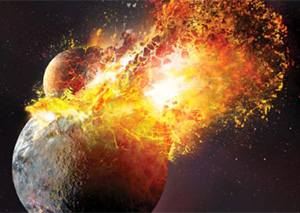
The products of vaporization, melting, and fragmentation — amounting to thousands of cubic kilometers (!) – are ejected by the shock wave into the homosphere to altitudes ranging from 10 km to 100 km. Subsequently, under the force of gravity, the material falls back to Earth; however, during extremely powerful impacts, part of the ejecta escapes into outer space (Fig. 2).
Space exploration has demonstrated that our world is not the only one subjected to regular bombardment. For example, in July 1994, Comet Shoemaker–Levy 9 collided with Jupiter, producing impact scars comparable in diameter to the Earth itself.
The numerous impact craters on the Moon — more than 300,000 craters exceeding 1 km in diameter – as well as on other planets, represent the most widespread geological structures within the Solar System.
6. An Authoritative Source of Knowledge
Apart from the opinions of modern scientists, clairvoyants, astrologers, and psychics, does there exist another independent source of knowledge capable of finally clarifying the question of the coming end of the world?
Such a source does exist — the Bible (Greek: "books"). It describes both the beginning of the creation of our world (the Old Testament, the Book of Genesis) and its end (the New Testament, the Book of Revelation of John). Of the 39 books of the Old Testament, 17 are prophetic, containing revelations – including those concerning the future – given to humanity by the Creator. The New Testament (the Gospels and Epistles) is likewise filled with eschatological prophecies, especially the manuscript known as Revelation (Greek: "Apocalypse").
Not only the prophetic books, but also other Old Testament manuscripts, written approximately between 1200 and 450 BC, contain individual predictions concerning future events affecting both the destiny of the Jewish people and that of the entire world. Altogether, the Bible contains 6,408 verses with prophecies, of which 3,268 have already been fulfilled.
For example, prophecies concerning Israel came to pass: the Jews would migrate to Egypt, live there for 400 years, become enslaved, and afterward depart from Egypt with great wealth; all those who refused to enter the Promised Land after 40 years of wandering in the desert would die; the people would reject theocracy, choose a king for themselves, and fall away from God; the king of Assyria would destroy the Northern Kingdom (Israel), while the Southern Kingdom (Judah) would fall into Babylonian captivity for 70 years; the Temple in Jerusalem would be destroyed and later rebuilt, and so forth.
The historical prophecies recorded in the books of Isaiah, Jeremiah, Ezekiel, Daniel, and the so-called "minor" prophets (750 ... 450 BC) were fulfilled in due time. This includes biblical prophecies concerning the birth, life, and death of the Messiah of the people of Israel (Jesus Christ).
According to the Gospels of Matthew, Mark, Luke, and John (written during the second half of the 1st century AD), Old Testament prophecies concerning the Messiah were fulfilled with astonishing precision – from the name of the town where He was born to His betrayal for thirty pieces of silver, the manner of His execution, and His resurrection from the dead.
Consequently, all the numerous Old Testament and New Testament prophecies concerning the end of postdiluvian human history must also come to pass. For the Creator of the universe declares through the prophet Isaiah: «declaring the end from the beginning and from ancient times things not yet done ...» (Isaiah 46:10, or "Long ago I spoke of things that have not yet happened today.")
7. A Conceptual Reconstruction of the Flood
The Bible informs us about significant historical events that actually took place. One example is the sudden worldwide Flood during the lifetime of Noah (the Book of Genesis, chapters 6 ... 8). However, to this day there is no scientific hypothesis explaining the causes of the universal Flood, the very existence of which is not recognized by the modern scientific community in a literal global sense, despite the biblical narrative and more than FIVE HUNDRED ancient legends preserved among different peoples throughout the world.
In this chapter, the author proposes a conceptual reconstruction of causes and events hidden from us in the darkness of millennia. The essence of the concept is as follows: at the beginning of the Holocene, already ongoing climatological processes underwent catastrophic acceleration due to the collision of a large asteroid – or one of its fragments – with the Earth.
This became the trigger for climatic destabilization: accelerated atmospheric warming occurred as a result of the so-called "greenhouse effect," glaciers melted relatively rapidly, the level of the World Ocean rose over the course of millennia, and the Holocene epoch became a period of post-catastrophic transformation of our planet.
Thus, within the framework of the scientific concept under consideration, the global Flood and the subsequent climatic changes were caused by a powerful cosmic impact event. For the territories of the Middle East, this event apparently occurred at the very beginning of the Mesolithic era (Middle Stone Age), meaning that the global catastrophe unfolded almost 12,000 years ago. More precisely, around 9900 BC, as follows from the reconstruction of ancient geography, climate, air temperatures, and the condition of the glaciers.
7.1. Ancient Glaciation
The current area of the Arctic is approximately 27 million km², but in that ancient era the surface area of Arctic ice was about 38 million km², since the air temperature over Greenland, according to analyses of ice-sheet cores, was nearly 20°C (!) lower than today. Ice covered the waters of most northern seas, the Baltic Sea, and the territories of many modern countries. For example:
In the Northern Hemisphere: Iceland, Ireland, Great Britain, Scandinavia, the Baltic region, Poland, Belarus, northern Germany, mountainous regions of other European territories, the northern part of European Russia, the Yamal and Taymyr Peninsulas, and the islands of the Arctic Ocean.
Nevertheless, the ocean surface was not completely frozen. Ice-free waters remained in the Chukchi, East Siberian, and partially the Laptev Seas; the northern regions of Yakutia, Chukotka, and most of Alaska had a relatively warm climate. In North America, Greenland and nearly all of present-day Canada, including the Rocky Mountains and parts of the United States, were covered by ice.
In the Southern Hemisphere, glaciation spread across the Andes mountain ranges, especially in Patagonia. The ice sheet covered almost all of Antarctica, the southeastern Indian Ocean, Tasmania, part of New Zealand, and the mountains in the far south of Australia, since the South Pole was located relatively close to it (approximately 70° south latitude and 140° east longitude).
7.2. Consequences of the Impact
Most likely, the planetoid approached from the south along the direction of the 40th meridian and struck the island of Greenland at a shallow angle to the surface of the ice sheet. From the center of the island northward, a continental fracture formed – the so-called "Great Canyon," approximately 750 km long, 10 km wide on average, and up to 800 m deep. Unfortunately, at present it is difficult to prove that the "Great Canyon" is an impact structure, since the ejecta layers, including traces of shocked quartz and iridium anomalies, are concealed beneath the ice dome.
The following cataclysms occurred: fragmentation of the island, large-scale vertical and horizontal displacement of masses, ruptures and transform faults in the crust, leading to the formation of the present-day Greenland lithospheric plate. The compressional shock wave displaced enormous masses of ice and soil by no less than hundreds of meters. In the affected zone, multi-kilometer-thick ice partially sublimated, fractured, and melted. Due to the colossal redistribution of masses both within the planet and on its surface, a gradual shift of the geographic poles relative to their former position began.
Because of tectonic deformations of the ocean floor, abrupt glacier displacements, underwater and surface earthquakes triggered throughout the world, eruptions of submarine volcanoes, and massive landslides, gigantic tsunamis and continuous torrential rains lasting many days flooded all continents and islands.
The beginning of the Middle Stone Age — that is, the Mesolithic archaeological era — is directly connected with the end of the last Ice Age. Following the cosmic catastrophe, the planet’s air temperature increased significantly. According to scientific estimates, during the very first century temperatures in the high latitudes of the Northern Hemisphere rose by 5 ... 10°C, and in some places even more (especially in Greenland). This was demonstrated by studies of ancient ice cores using the unique paleoclimatological method based on isotopic analysis.
For this reason, in addition to the ice dome of Greenland that had already partially melted from the asteroid impact, there began a gradual melting of ice in Canada, the Arctic Ocean, the northern Atlantic basin, and the northern regions of the United States and Europe throughout the so-called "Greenland stage of the Holocene." Millions of cubic kilometers of fresh water flowed into the oceans and seas.
The level of the World Ocean rose by 18 meters over the course of several centuries, and the waters submerged the ruins of ancient cities destroyed by the immense impact-induced earthquake. Over the entire Holocene period, the level of the World Ocean rose, according to various scientific estimates, by 35 to 130 meters; inland seas formed in Eurasia, including the Azov and Black Seas.
Almost all inhabitants perished by drowning — approximately 5 million people (according to demographers and historians, the world population at that time ranged from 1 to 10 million). Around 75% of large animal species on the planet, primarily in the Northern Hemisphere, either died out immediately or gradually became extinct. Woolly mammoths and rhinoceroses, mastodons, glyptodonts, steppe bison, giant bears and sloths, saber-toothed tigers, North American lions, Irish elk, and many other smaller animals disappeared.
8. What Is the Fate of the Present Human Race?
According to the Book of Genesis, the previous highly developed civilization was destroyed because it had been corrupted by evil. The moral depravity of humanity had become immeasurably great. «The Lord saw that the wickedness of man was
great in the earth, and that every cintention of the thoughts of his heart was only evil continually.» (Genesis 6:5).
The new human race, descended from the surviving family of the righteous Noah, is now in a similarly sinful spiritual condition, for there is neither fear of God nor reverence for Him. The deceitful call good evil and evil good; war is described as a means of achieving peace, while peace itself is called a cold war. The entire planet has become filled with wickedness, and therefore the end will come.
Wherever human beings appear, nature inevitably begins to suffer. Today, the only fundamental difference from the fallen ancient world is that modern humanity, in addition to constantly devising evil, is destroying the natural environment at an ever-increasing pace. Yet what was not created by humanity should not be destroyed by it.
The evil, deceitful, and envious human race, gradually degenerating, has in fact already perished spiritually. A society that has turned its back on its Creator will be purified from sin by fire. Together with humankind, domestic animals and wild beasts, birds and fish will perish as well; along with the wicked, the stumbling blocks themselves will be destroyed, as foretold by the prophet Zephaniah.
In the time of punishment — the Old Testament “Day of the Lord” — nothing will help sinners, not even great wealth. «Neither their silver nor their gold shall be able to deliver them on the day of the wrath of the Lord. In the fire of his jealousy, all the earth shall be consumed; rfor a full and sudden end he will make of all the inhabitants of the earth.» (Zephaniah 1:18).
The prophet Isaiah sees terrible traps set everywhere: pits, fissures, and snares. In those days, whoever flees from terror will fall into a pit with a cry; whoever escapes from the pit will be caught in another snare, for the heavens will be torn apart and the earth itself will split open in response.
Isaiah foretells that only one-tenth of his people will survive. The prophet Zechariah speaks of the death of two-thirds of the Israelites, while the remaining third will be refined by fire. Isaiah, Jeremiah, and Amos declare that their state will be devastated, multitudes of sinners will perish, and only a small remnant will remain alive.
The Apostle John was also granted visions of the end of humanity — the New Testament «Great Tribulation.» From the revelations given to him, it follows that one-third of the population of all nations will perish by fire, smoke, and sulfur; one-fourth will die from violence, famine, epidemics, and wild beasts; many will perish because of poisoned, bitter waters. At the same time, the disciple of Jesus Christ does not claim that the end of the human race will come as the result of a world war among nations.
Thus, the conviction of certain scientists regarding the high probability of the destruction of technological civilization and the physical death of much of humanity is echoed by biblical prophecies made two to three thousand years ago. Christianity and science are not rivals, but sisters. Alas, we read without understanding, we hear yet do not believe; then we shall see… and be horrified.
9. Global Cataclysm
Some futurologists believe that the end of the world will come as the result of a large-scale natural catastrophe. Their opinion does not contradict the Bible, for the pre-Flood world indeed perished as a consequence of natural disasters.
According to certain scientists, the catastrophe will have a cosmic nature, caused by the collision of Earth with a dwarf planet several kilometers in diameter. An object of such size is capable of triggering natural disasters, widespread destruction, and severe climatic changes.
Surprisingly, this hypothesis corresponds rather closely with biblical eschatology – the doctrine of the last days – which was formulated long before the scientific era of history. For example, the prophet Jeremiah describes a stone invading the atmosphere as a boiling cauldron: «I see a boiling pot, facing away from the north.» (Jeremiah 1:13; literally, "it is moving from the north"). Likewise, Isaiah foresees: « For smoke comes out of the north, and there is no straggler in his ranks.» (Isaiah 14:31).
Daniel was also shown the mystery of the destruction of the final kingdom, symbolized by the feet of the great statue made of iron and clay. That kingdom will be shattered by a stone (Fig. 3), cut out from the great cosmic mountain without the aid of human hands.
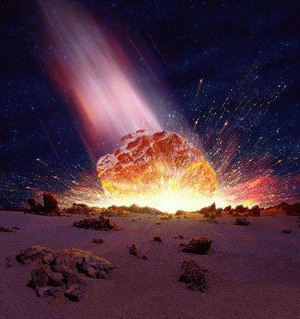
After flying through the atmosphere, the stone struck the feet of the statue and shattered them. «Then the iron, the clay, the bronze,
the silver, and the gold, all together were broken in pieces, and became like the chaff of the summer threshing floors; and the w ind carried them away, so that not a trace of them could be found. But the stone that struck the image became a great mountain and filled the whole earth.» (Daniel 2:35).
Other biblical authors refer to this dangerous inanimate body as the morning star (Isaiah), the destroyer of nations, the destroying and burnt mountain (Jeremiah), Gog (Ezekiel), and Leviathan (Job).
In one of his revelations, the Apostle John sees Jeremiah’s boiling cauldron, calling it a censer filled with fire cast down from heaven. This is why the following events occur:
- hail and fire fall, causing trees and grass to burn; then,
- «something like ha great mountain, burning with fire» (Revelation 8:8) is cast into the sea (the World Ocean), causing one-third of marine life and one-third of all ships to perish; afterward,
- a star falls from heaven onto the land – more precisely, an asteroid (Greek: "star-like"). From the immense thermal explosion there arises the «the shaft of sthe bottomless pit» (Revelation 9:1, 2) that is, an astrobleme several kilometers deep, from which smoke emerges – the products of the impact ejecta. The Apostle sees that because of the «by the fire and smoke and sulfur» one-third of the inhabitants of the earth perish (9:18).
Therefore, when Jesus Christ speaks about the moment when He will reveal Himself to the world, He compares it to an episode from the life of the Old Testament Lot: «on the day when Lot went out from Sodom, fire and sulfur rained from heaven and destroyed them all» (Luke 17:29).
10. The Asteroid of the Apocalypse
Although humanity has risen higher than the eagle flies and built its nest above the loftiest mountains, even from there the Almighty will cast it down. The destroyer of the Earth will be the biblical Gog and his anthropomorphic host — a meteoroid-asteroid stream of distant galactic origin.
These visitors from space may represent an extremely diffuse cloud of dust, sand, stones, rock fragments, and both small and large asteroids. From 95% to 98% of the mass of the swarm is concentrated in its central object – scientifically speaking, a planetoid-like body. The length of this swarm of cosmic intruders, stretched out along the direction of motion, may reach 50 ... 100 million kilometers, with a diameter of 30 ... 40 million kilometers and a velocity ranging from 20,000 to 140,000 km/h.
The central object – let us call it Gog – apparently originated as the result of a collision and fragmentation of large planetary bodies. According to astrophysicists, such destructive events typically produce seven major fragments, numerous large and small debris pieces, and enormous quantities of sand and dust.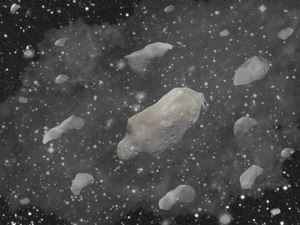
One of these seven massive fragments is the biblical Gog from the land of Magog. He is surrounded by many nations, all riding upon horses – "a great host, a mighty army" (Ezekiel 38:15; Fig. 4), as the prophet Ezekiel described it in the concepts, terminology, and beliefs of his era.
The seer Isaiah calls the instrument of God’s wrath a fiery chariot:
«For behold, uthe Lord will come in fire, and vhis chariots like the whirlwind (or "His armies are in clouds of dust"), to render his anger in fury, and his rebuke with flames of fire.» (Isaiah 66:15).
John, meanwhile, uses prophetic personification in his description, transferring the characteristics of beasts onto an inanimate object. Thus his great red dragon, the scarlet beast, and the beast rising from the sea all possess seven heads. The apostle explains: «the seven heads are seven mountains » (Revelation 17:9) and also seven kings and ten horns.
The ten horns in John’s visions are evidently bolides leaving behind long narrow trails of glowing gases. They will receive power over the planet “for one hour,” like a caliph for a fleeting moment; «tThey will make her gdesolate and hnaked, and idevour her flesh and jburn her up with fire» (Revelation 17:16).
The host of Gog will appear from the direction of the constellation Cepheus in the northern celestial hemisphere. Of all the planetoids falling upon the Northern Hemisphere, the largest will collide head-on with the Earth – between the Arctic Ocean and the Atlantic Ocean, near the northern coasts of Canada and Greenland.
People will perish from widespread powerful earthquakes, gigantic gravitational waves (tsunamis), volcanic eruptions and supervolcano explosions, vast forest, steppe, and savanna fires driven by hurricane-force winds, falling masses of ice from the sky, scorching acidic rains lasting for many days, floods, landslides, mudflows, avalanches, and rockfalls, followed by famine, cold, and disease.
11. Job’s Leviathan
In the Old Testament Book of Job, there appears an even more ancient image of the uninvited guest from the cosmic abyss, for «he is king over all the gsons of pride» (Job 41:34).
The text speaks of a chthonic monster which, according to archaic beliefs, dwelt in the abyss. The Hebrews called it Leviathan, Rahab, Tannin, and Nahash. In Ugaritic and Canaanite traditions, it was known as Lotan (Arshu), the seven-headed twisting serpent mentioned by the prophet Isaiah and the psalmist Asaph.
Behind the image of the mythical tailed dragon, often breathing fire and present in the mythologies of many peoples, there lies a very real though rare phenomenon – the flight of a meteor body brighter than fourth stellar magnitude. Scientifically, this is called a "bolide" (meteoroid), a solid object up to 50 meters in size, intermediate between cosmic dust and an asteroid.
Entering the homosphere at enormous velocity, the meteoroid becomes heated through collisions with gas molecules. As a result, there appear an extensive luminous оболочка of gases heated to temperatures of 1,800°C to 3,000°C, sparks from material evaporating off its surface, and a long tail of "smoke". The flight of the fiery sphere is visible even in daylight, while at night it illuminates the landscape for hundreds of kilometers.
Job, relying on the ancient understanding of nature – according to which everything in the world was animate – describes the astonishing properties of Leviathan:
«Around his teeth is terror. His sneezings flash forth light. Out of his mouth go flaming torches; sparks of fire leap forth. Out of his nostrils comes forth smoke, as from a boiling pot and burning rushes. On earth there is not his like, a creature» (Job 41:14, 18-20, 33).
Expressed in scientific terms, this resembles the vision of an intense meteor-stream radiant with a zenithal hourly rate (ZHR) exceeding 10,000 flashes per hour. The visionary calls this astronomical phenomenon the monster’s "mouth," while the trails of meteoric bodies become its dreadful ring of teeth. From the "mouth" leap meteors – "sparks of fire" – and blazing bolides, "burning rushes," with long smoky tails issuing as though from the nostrils of the beast.
As a rule, a meteoroid does not reach the Earth’s surface but explodes in the atmosphere – the "sneezing" of the beast – accompanied by a brilliant flash: «His sneezings flash forth light.» Afterwards, small meteorites fall like "burning rushes."
Compared with Job’s Leviathan, the terrible chimera of the prophet Daniel, the great red dragon, the scarlet beast, and the beast from the sea described by the Apostle John are portrayed less vividly. Yet the consequences of these monstrous assaults become no less terrifying.
As a result of the cosmic bombardment, the end of the world will come, for the Creator of the universe will pour out His righteous wrath. He will judge the world according to its deeds and lay upon this degenerate generation all its abominations. Yet everything might have been otherwise, had humanity listened to the biblical prophets.
«He has told you, O man, what is good; and fwhat does the Lord require of you but to do justice, and to love kindness, and to gwalk humbly with your God?» (Micah 6:8).
For life on Earth is given so that humanity may learn to distinguish good from evil, to do good while turning away from wicked deeds and thoughts, and to return to its Creator. Unfortunately, harmony can no longer be achieved without suffering.