«But the day of the Lord will come like a thief, and then
the heavens will pass away with a roar, and the heavenly
bodies will be burned up and dissolved, and the earth and
the works that are done on it will be exposed»
(2 Peter 3:10)
and these were thrown upon the earth ... and something
like ha great mountain, burning with fire, was thrown into
the sea ... and ka great star fell from heaven, blazing like
a torch ..." (Revelation 8:7-10)
The destruction of a godless civilization is referred to in the Old Testament as the "Day of the Lord," and in the New Testament as the "Great Tribulation." The Bible reveals the tragic consequences of a future large-scale catastrophe characterized by a cascading mechanism of development. Prophecies concerning natural disasters and the end of the world are fragmentarily contained in many prophetic books, being united into a single whole by the futuristic work The Revelation of John.
Let us consider the principal stages of an extraordinary impact cataclysm – the possible collision of our planet with a meteoroid-asteroid stream from deep space surrounding a dwarf planet. We shall examine this subject in the context of ancient biblical prophecies, elucidating their meaning and refining it with the aid of modern scientific knowledge, which points to the following established facts.
Fact No. 1. During the last century, Earth was visited by three massive extraterrestrial objects: the Tunguska stony body (asteroid), the Sikhote-Alin iron meteoroid, and the Chelyabinsk bolide (meteorite).
Fact No. 2. Numerous traces of asteroid impacts exist on Earth in the form of astroblemes; approximately 200 impact craters have been officially confirmed. Wikipedia provides a list of impact craters with diameters exceeding 20 km. The largest of them has a diameter of about 300 km (the Vredefort crater).
Fact No. 3. Recently, a group of scientists demonstrated that the ancient Chicxulub structure on the Yucatán Peninsula (Mexico) is an impact crater (approximately 180 km in diameter), with an original depth of 17–20 km, formed by the impact of an asteroid 10–12 km in diameter. The impact energy is estimated at 5 × 10²³ joules, while the temperature at the epicenter reached several tens of thousands of degrees.
The impact vaporized soil and water, triggered an earthquake of magnitude 11–12, and generated destructive tsunamis hundreds of meters high upon reaching coastlines. The atmospheric shock wave and ensuing fires destroyed everything within a radius of hundreds of kilometers. Enormous quantities of coarse aerosol particles were injected into the atmosphere, blocking sunlight for several years. Acid rain followed, contaminating water and soil. Suppressed photosynthesis led to the mass extinction of plants, phytoplankton, and other microorganisms.
Consideration of these and other facts, including biblical eschatological prophecies and the account of the global Flood during the days of Noah, makes it possible to reconstruct a complex system of interconnected processes—the entire chain of events of a future and highly probable analogous cataclysm.
This article proposes a physical reconstruction of future events based on contemporary concepts of a global cosmic catastrophe. Certain elements of this reconstruction are based on the author's interpretation of prophetic texts and do not belong to generally accepted scientific models.
1. Space dust fall
A conceptual reconstruction of future developments as a synthesis of natural-scientific knowledge and prophecy appears as follows.
The intersection of Earth's orbit by these uninvited cosmic visitors will begin with the entry of cosmic dust into the atmosphere. In the author's opinion, the meteor trails (tracks) will appear to originate from the direction of the circumpolar constellation Cepheus in the northern celestial hemisphere.
At first, the smallest peripheral solid particles will enter the atmosphere, ranging in size from 0.1 to 0.001 mm and in mass from 10⁻⁶ g to 10⁻¹³ g. The possible initial velocity of meteors visiting our planet is 11–73 km/s, while the most probable velocity for large objects is 20–40 km/s.
As meteor bodies collide with gas molecules, they will rapidly heat up and then completely "burn up" at altitudes of 130–60 km above the Earth's surface. More precisely, they will undergo sublimation—instantaneous vaporization—with the exception of the smallest dust particles less than 4 microns in size (the so-called "micrometeorites"), which pass through the atmosphere with almost no loss of mass.
As a result of the sublimation of these cosmic bodies, meteor flashes will occur – narrow bright trails (tracks) of the 4th to 1st stellar magnitude, caused by the glow of the incandescent gases produced by the vaporizing particles. When the number of flashes exceeds 10,000 per hour, the radiant of the meteor stream will be clearly visible on a cloudless night (Fig. 1).
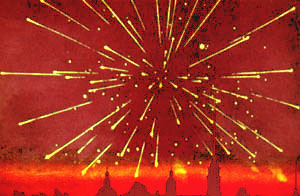 This astronomical phenomenon is a small area of the sky – an apparent "opening" from which, due to the effect of perspective, all visible meteor trails, or those mentally extended backward, seem to emerge, although in reality the meteors are traveling along parallel trajectories.
In ancient times, this unusual effect, caused by the Earth's encounter with the dust of long-active comets, was called a "starry rain," which was believed to portend various misfortunes, while the central region was referred to as an opening above one's head.
The origins of these beliefs can be traced to the words of Jesus Christ:
«and qthe stars will fall from heaven, and the powers (bodies) of the heavens will be shaken (set in motion). Then rwill appear in heaven sthe sign of the Son of Man, and then tall the tribes of the earth will mourn» (Matthew 24:29–30, ESV).
The Apostle John sees the same future sign as already fulfilled: «and lthe stars of the sky fell to the earth » (Revelation 6:13). One of the Old Testament prophets foresees that, on the day of God's wrath, «All the host of heaven shall rot away, and the skies roll up like a scroll. All their host (the stars) shall fall ...» (Isaiah 34:4, ESV).
2. The fall of meteorites
According to the modern physical theory of meteoroid-asteroid streams, the cosmic dust crossing Earth's orbit will, within a few days, be supplemented by meteoroid bodies ranging in size from 0.1 mm to 50 meters and in mass from fractions of a gram to thousands of tons. During their deceleration in the Earth's atmosphere, their surface temperature rises to approximately 3,000°C.
Small meteoroids traveling at velocities exceeding 25 km/s burn up completely. Others lose part of their mass (sometimes up to 90%) as a result of ablation—the removal of material from the surface by a flow of hot gas. As they decelerate, their trajectories gradually become nearly vertical, allowing them to reach the surface of our planet after having cooled; such surviving remnants are called meteorites.
A large meteor appearing as a fireball with a long, bright tail—brighter than 4th stellar magnitude—composed of incandescent gases and particles is called a bolide (from the Greek term meaning "throwing spear"; Fig. 2).
Typically, a bolide does not reach the Earth's surface, disintegrating in the atmosphere and producing numerous small fragments that fall as a so-called "meteorite shower." Ancient peoples perceived bolides as fire-breathing, tailed dragons flying across the sky.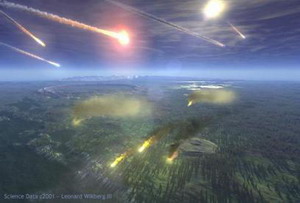
In the Bible, these cosmic visitors are referred to as God's arrows and spears, consuming fire, flame, chariots, great stars, and a torch, while meteorites are described as fiery rain, hailstones of stone, glowing coals, and burning sulfur.
For example, in one prophetic vision, the Apostle John saw that «a great star fell from heaven, blazing like a torch, and it fell on a third of the rivers and on the springs of water» (Revelation 8:10).
By the term "great star," the Apostle refers to a bolide burning like a torch, illuminating the landscape for hundreds of kilometers with a bright, flickering light. This remarkably accurate comparison is not accidental: a torch in the wind or in motion leaves behind a tail of smoke and sparks and emits a wavering light.
The visionary then relates something seemingly incredible: the cosmic wanderer (the "star") falls upon a surface of enormous extent. Yet this vision is also realistic, since a solid body with a mass of up to one ton generally breaks apart in the homosphere at altitudes between 80 km and 20 km.
Meteoroids disintegrate under the combined effects of aerodynamic pressure and internal thermal stresses caused by aerodynamic heating during atmospheric deceleration. Countless small fragments descend from the region of deceleration and are scattered over a vast area in the form of an ellipse.
3. Conceptual Reconstruction of an Impact Cataclysm
Along with the phenomena described above, the Apostle John saw «something like a great mountain, burning with fire, was thrown into the sea» (Revelation 8:8).
The great mountain burning with fire is referred to by the biblical prophet Jeremiah as a boiling pot: «And I said, ‘I see a boiling pot, facing away from the north. Then the LORD said to me, ‘Out of the north disaster shall be let loose upon all the inhabitants of the land» (Jeremiah 1:13–14).
Isaiah declares: «Smoke comes out of the north, and there is no straggler in his ranks» (Isaiah 14:31). The fall of a burning mountain-pot surrounded by a cloud of smoke will cause a Great Unprecedented Earthquake on all continents. Near the epicenter, the roar of the explosion may rupture eardrums, while its powerful rumble will be heard by people anywhere on the planet.
It should be taken into account that massive cosmic bodies reach the Earth's surface with virtually no atmospheric deceleration. Therefore, during an impact, almost all of the asteroid's enormous kinetic energy is converted into thermal energy, as well as into the energy of a powerful light pulse, the motion of matter behind the shock-wave front, and a hot column of dust, vapor, and water (the so-called plume) ejected to altitudes of up to 100 km.
With high probability, a powerful hurricane will arise – or, more precisely, a theoretically possible hypercane – with wind speeds ranging from 500 to more than 800 km/h and covering an area comparable in size to North America. A continuous wall of flame associated with the supersonic shock wave, that is, a fiery vortex with an initial temperature of several hundred thousand degrees, will destroy everything within many hundreds of kilometers of the impact site.
Something similar was foreseen by Isaiah more than 2,700 years ago: «you will be visited by the LORD of hosts with (Masor," The Lord will be punished Tsevaota) thunder and with earthquake and great noise, with whirlwind (hurricane) and tempest, and the flame of a devouring fire» (Isaiah 29:6).
Indeed, during the active phase of cosmic bombardment, not only stone hail (meteorites) and flying spears (bolides) will fall upon water, ice, and land, but also very large objects – asteroids, or, in scientific terminology, planetoid bodies (known as "minor planets" prior to 2004).
The equivalent diameters of such unexpected cosmic visitors range from 50 m to 15 km and more; their masses range from several thousand tons to several trillion tons; and their velocities range from 70,000 to 140,000 km/h. During flight, the bow shock wave and the plume heat local regions of the Earth's homosphere to temperatures of several thousand degrees.
3. 1. Consequences of a collision with an asteroid
According to calculations, upon impact with the ground or water, the pressure reaches 10⁹ bar, and the penetration depth is 30–40 km, depending on the angle of impact and the amount of energy released instantaneously at the point of impact. This energy can be enormous – up to 5×10²⁴ J or over a billion megatons in TNT equivalent.
This is enough to completely vaporize a planetoid and disrupt the continuity of rock formations – that is, the integrity of the continental crust or the ocean floor. At the same time, all seismic faults on Earth will become active. The planet will shake incessantly for several weeks, accompanied by volcanic eruptions and supervolcanic explosions due to the destabilization of the magma.
Consequently, such a collision would produce catastrophic consequences – both direct effects and, to an even greater extent, induced secondary effects. These consequences would encompass all three classes of adverse and hazardous natural phenomena and processes: atmospheric, hydrospheric, and lithospheric. For example, the impact of a planetoid body would generate a gigantic fireball with temperatures at the epicenter reaching several tens of thousands of degrees.
The resulting thermal pulse could cause burns to the retina of the eyes as well as to exposed areas of the body at distances of hundreds of kilometers from the epicenter. As the fireball rises, ascends to altitudes of 10–100 km, and expands, it will draw enormous quantities of matter into the low-pressure zone beneath it, including gases, water, mineral dust, sand, rock fragments, and other materials.
As a result of the thermal explosion, a powerful shock wave will form – a narrow transition region (the so-called front) in which the density, pressure, and temperature of matter increase abruptly. According to modeling results, at the explosion site the shock pressure may reach 100 gigapascals (up to one million atmospheres), the initial temperature at the shock front may exceed 10,000°C, and the initial propagation velocity of the front may exceed the speed of sound severalfold. As the distance from the impact point increases, the magnitudes of these parameters decrease.
The propagation velocity eventually becomes comparable to the velocity of a bullet (350–1,200 m/s), while the temperature drops to approximately 400°C. However, even at distances of hundreds of kilometers from the impact crater, the movement of the shock front still exceeds the speed of sound in air (330 – 343 m/s depending on its temperature). At very great distances, the supersonic wave degenerates into an ordinary sound wave, and its propagation velocity decreases, approaching the speed of sound in the surrounding medium.
4. Reconstruction of the Arctic Impact Scenario
According to the eschatological vision of the Apostle John, out of all 666 bodies, only ten will collide with the Earth—and specifically in its Northern Hemisphere, as follows from the analysis of biblical prophecies.
According to the author's reconstruction model, one of the largest asteroids will impact between the Arctic Ocean (Lincoln Sea) and the Atlantic Ocean (Baffin Bay). More precisely, between the northern coast of Greenland and Ellesmere Island of the Canadian Arctic Archipelago, in the area of the Arctic Mobile Fold (Geosynclinal) Belt.
The equivalent diameter of this asteroid will presumably be about 15 km, and its mass approximately 5 trillion metric tons, which is comparable to the mass of the ice sheet of the entire Arctic (∼ 9,000 km³). Its speed relative to the Sun is approximately 30 m/s, and relative to our planet, 42.28 m/s – accounting for the gravitational attraction of the Earth, this corresponds to 43.74 m/s, with an impact angle of approximately 70° relative to the horizontal surface.
The initial kinetic energy before the collision will amount to approximately 4.784 х 1024 Joules (TNT equivalent: 1.14 х 109 Мт). This minor planet will fall almost vertically onto the ice of the Kane Basin in the Nares Strait. According to the author's calculations, the impact site lies at approximate coordinates: 79.5° North latitude and 68° West longitude.
A crater will form from the mechanical shock and thermal explosion: the initial depth, the so-called "transient cavity," will be 30 – 40 km, with an initial diameter of ∼ 140 km. In less than a minute, the crater will expand to a diameter of 270 km, while its depth will decrease to 1.2–1.5 km.
In a zone with a radius of up to 250 km from the impact epicenter, water and ice (approximately 1,500 km3) and part of the bedrock (tens of cubic kilometers) will instantly transform into supercritical steam and gas, accompanied by the formation of an incandescent impact plume. In a zone with a radius of up to 500 km, significant volumes of matter (up to 50,000 km3) will melt, shatter, and be ejected beyond the crater boundaries. The 1,000 km radius zone represents the region where ice and rock suffer shock fracturing and seismic shaking.
The edges of Greenland and Ellesmere Island closest to the explosion epicenter will be completely destroyed, submerging under water and crushed ice. A portion of Greenland may be separated as an independent geological block over the following decades and centuries as the island's mass moves as a whole, or even instantaneously at the moment the transient cavity forms. This will be facilitated by:
complete fracturing and partial melting of the crust in the central impact zone;
gigantic radial and ring faults;
detachment of individual crustal blocks;
formation of zones where the crystalline crust will be effectively severed;
severe disruption of the coupling between the upper crust and deeper parts of the lithosphere.
Ultimately, the overall consequence of the massive shock deformation and thermal explosion will be the partial destruction and fracturing of the island of Greenland, accompanied by a slight rotation of the island's main mass and its ice sheet around the center of mass ("pole of rotation"). Certain coastal areas may become detached during the first seconds of the impact or at a later stage.
4.1. Hydrospheric Transformations
At the moment of collision between the asteroid and our planet, Greenland's ice sheet will shift into the Greenland Sea (with an initial velocity of approximately 15 m/s) over a distance of 250 m to 600 m. The island's bedrock will also shift, though at a lower velocity and over a significantly shorter distance.
In the immediate impact zone, initial water-impact structures with heights ranging from 3 km to 5 km will emerge, rapidly restructuring and partially collapsing within the first few minutes to form far-propagating wave systems of much lower height. Thus, in the seas surrounding Greenland, tsunamis with heights of 150–300 m triggered by the thermal explosion itself will rise, along with inertial waves of 50–100 m caused by the displacement of the ice sheet and bedrock.
Inertial waves are significantly lower in height than "explosive" waves, but they possess a much longer wavelength and water mass. They will advance onto the land in a continuous flow, inundating it for tens to hundreds of kilometers. For example, the tsunami height upon entering European territories will range from 30 m to 100+ meters (Iceland > 150 m, Scotland and Northern Ireland > 120 m).
Iceland, Ireland, Scotland, Great Britain, Norway, the Netherlands, Denmark, Belgium, Germany, France, and Canada will suffer the most from marine waves. To a lesser extent: islands of the Arctic Ocean, Alaska, and the northern coast of Russia. After all, wave height depends on distance to the impact epicenter, continental shelf and seafloor topography, coastal steepness, etc.
Presumably, the seafloor in the area of the Faroe-Iceland Ridge and the Wyville-Thomson Ridge will rise. As a result of this and other factors, the circulation scheme of the Gulf Stream may change – particularly north of Great Britain and Scandinavia, and possibly across the entire North Atlantic Ocean. Other ocean currents may also alter their trajectories.
4.3. Tectonic Deformations
For instance, according to the author, the Greenland portion of the North American Plate will collide with the northeastern part of the Eurasian Plate, causing deformations in the boundary zone: destruction, fracturing, and subduction of crustal sections into the mantle. In turn, the Eurasian lithospheric segment will push the African, Arabian, and Indian blocks. The North American Platform will override the Caribbean, South American, Pacific, and Cocos plates across the asthenosphere.
The South American crustal segment is expected to thrust onto the Scotia Plate, which is pressed against the Antarctic Plate. The most significant tectonic changes will obviously be experienced by smaller plates: Caribbean, Cocos, Nazca, Scotia, Sunda, and many smaller units down to microplates – such as the Anatolian, Panama, and Timor microplates, as well as consolidated blocks of the Molucca Sea.
On the floor of the Arctic, Atlantic, and Pacific Oceans, new mid-ocean ridges, fold mountains, and deep-sea trenches will most likely form. Islands will appear in the Caribbean, Java, and South China Seas, as well as in the Drake Passage. Certain sections of the ocean floor and landmasses will collapse, particularly in spreading zones and areas of severe earthquakes.
From the overwhelming strike, «the earth will be shaken out of its place» prophesies Isaiah (Isaiah 13:13); hence «every mountain and island was removed from its place» as seen by the Apostle John (Revelation 6:14).
In modern scientific terms, the impact will impart an additional angular momentum to the Earth relative to its axis. This quantity is determined by the angular rotational velocity of the body, its mass, and its spatial mass distribution.
5. The Earth Will Be Moved Out of Its Place
The additional angular momentum acquired by our planet from the asteroid collision will alter—though slightly—its orbital parameters: orbital eccentricity, orbital velocity, and rotational velocity around its own (imaginary) axis. Consequently, the length of the day will change (by approximately one millisecond).
However, due to the Earth's immense axial moment of inertia, the tilt angle between its rotational axis and the perpendicular to the orbital plane (∼ 23.44о) will remain virtually unchanged according to modeling (changing only by millionths of a degree). Nevertheless, the positions of the Geographic North and South Poles will alter immediately and then gradually shift as a result of mass redistribution of rocks within the planet and ice masses on its surface.
The appearance of the starry vault will also change due to precession—that is, through a change in the spatial orientation of our planet's axis. Precession and nutation (nodding) occur under the influence of gravitational forces from the Moon and Sun, as well as mass redistributions inside and on the surface of the Earth. This is precisely why the orientation of its axis toward a specific star completes a precession cycle over 25,765 years (i.e., at a rate of ∼ 1о per 71.6 years), slowly altering the night sky appearance.
As a result of the impact, the moment of inertia tensor – which relates angular velocity to angular momentum – and the azimuthal orientation of our planet's rotation axis will change. Therefore, over time, the position of the celestial north pole will change for an observer on Earth, along with the visible position of all stars and constellations on the celestial sphere. In the zodiacal belt, this will manifest as a shift of approximately 30о relative to current positions. This does not mean physical movement of the stars themselves: it is the direction of the Earth's axis – the frame of reference tied to Earth's rotation – that changes.
Now, as a result of an extraordinarily powerful cosmic strike, the direction of the planetary axis toward Polaris will begin shifting toward Gamma Cephei not over the usual 2,150 years, but significantly faster (the celestial pole is currently shifting toward it). Eventually, all night luminaries in the firmament will occupy new positions, particularly within the zodiacal belt. At the same time, it is crucial to note that the inclination angle of the Earth's axis of rotation relative to the ecliptic plane will remain constant (∼ 66.5о).
Furthermore, this 30о azimuthal shift does not necessarily establish itself instantaneously at the moment of impact. The initial impulse will alter the Earth's angular momentum vector, after which the axis will begin transitioning to a new direction. Part of this orientational change may occur rapidly, while the final establishment of the new position will unfold over the subsequent precessional period. Subsequent slow changes in the azimuthal orientation of the Earth's axis will occur against the backdrop of this new state, driven by accelerated precession from the additional angular momentum.
The author's reconstruction demonstrates that for an observer on Earth, the constellation Pisces will gradually shift into the position currently occupied by Aries. The Sun will then rise among Pisces not in March/April (currently March 11 to April 18), but in April/May (currently April 18 to May 13 in Aries). The vernal equinox point will slowly shift into Aquarius, and the autumnal equinox into Leo. Naturally, the visible trajectories of Solar System planets across the night sky will also change for a terrestrial observer.
Based on the stated facts, modeling, and calculations, the following preliminary conclusion can be reasonably drawn: as a result of the collision with a massive asteroid, large-scale deformations of the Earth's crust, lithospheric plate collisions, and horizontal and vertical mass shifts in the upper mantle will occur. This will trigger a massive release of trillions of tons of steam, boiling water, and mineral rock into the atmosphere. Within a radius of hundreds of kilometers around the thermal explosion center, ice will undergo sublimation, melting, or destruction, accompanied by the transformation of sedimentary and crystalline rock.
6. Consequences of the Global Cataclysm
The Earth may collide not only with a single planetoid measuring 19 km in diameter and weighing 5 trillion tons, but with an entire group of smaller cosmic intruders.
If one of the asteroids, say 2 km in diameter, strikes land, the area of total destruction will extend roughly 500 km, while a region of 4 million km² will be engulfed by earthquakes, hurricanes, and floods. Across a territory measuring 800 × 800 km, wind speeds will exceed 500 km/h, and a firestorm zone will cover an area of approximately 200 × 200 km (Fig. 3). A powerful electromagnetic pulse will disable all operating electronic equipment and communication systems.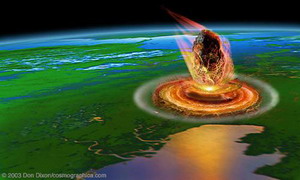 Thousands of cubic kilometers of matter will be ejected into the atmosphere – approximately 10 times the mass of the asteroid, or about 100,000 tons of ejecta per megaton (TNT) of thermal explosion energy. After a few hours, burning fragments of rock, stones, and sand will partially fall back.
The impact of a minor planet 10 km in diameter will form a boiling lava lake spanning hundreds of kilometers. Up to 10,000 km3 of material will be ejected, including between 300 and 2,000 billion tons of fine mineral dust (0.6 dots 4 kg per 1 m² of surface). Therefore, it is more appropriate to evaluate the impact energy using the Kanamori scale based on seismic moment.
The moment magnitude of the earthquake will reach 11–12 on the Kanamori scale, and upper atmospheric temperatures will rise by tens to hundreds of degrees. "Star wounds" (impact craters) up to 200 km in diameter and roughly 10 km deep will form – measured as the distance between the rim and the surface of the breccia at the bottom. The initial transient crater depth from a 10 km asteroid will exceed 20 km.
John refers to the immense shaft resulting from the star falling from heaven as the «the shaft of the bottomless pit» (Revelation 9:1–2). The New Testament seer interprets the atmospheric ejection of hot impact gases, water vapor, soot, fine mineral dust, and sand (the impact plume) as smoke arising out of the pit «like the smoke of a great furnace». Due to colossal volumes of ash, soot, dust, and coarse particulate matter slowly settling over several years, the sky will darken and the sun will dim.
If the energy released during the impact were a mere 10,000 megatons of TNT, solar radiation reaching the surface in the affected zone would decrease 400-fold, and atmospheric self-cleaning would take many months. A drastic reduction in solar radiation penetrating the heavily dust-laden and sulfate-aerosol-saturated atmosphere will trigger severe global cooling.
Air temperatures over some continents will plunge to minus 50 °C or lower. At the same time, a global multi-year "asteroid winter" and total planet freezing will NOT occur due to the greenhouse effect created by atmospheric water vapor, carbon dioxide, methane, aerosols, and other gases.
Through infrared re-radiation, these gases will reduce thermal heat loss to space and raise air temperatures. A drought prophesied by Zechariah, Joel, and Isaiah will ensue. Photosynthesis will be interrupted for at least a year, crops will produce unripe grain, and fruit trees will fail to set fruit (prophecies of Hosea, Habakkuk, and Joel).
Global ocean ecosystems will undergo massive transformations, notably in the circulation of major ocean currents: Gulf Stream, Kuroshio, El Niño, and currents in the Arctic and Antarctic Oceans.
Our planet's magnetic field, orbit, and rotational speed will shift slightly, affecting the length of the day, month, and year. The position of the poles and azimuthal rotation direction will alter. Several cosmic wanderers may be captured by Earth's gravity, giving rise to additional night-visible satellites alongside the Moon.
6.1. Planetary-Scale Earthquake
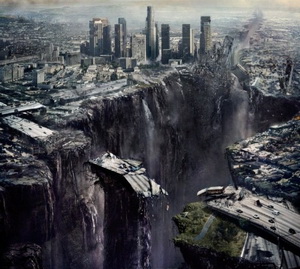 Another catastrophic consequence of the impact from space will be a geophysical natural disaster – a global earthquake (Fig. 4).
Through the Old Testament prophet, the Lord warns: «I will shake the heavens and the earth and the sea and the dry land» (Haggai 2:6). The same event is foreseen by Isaiah, Ezekiel, and John.
The Apostle envisions it as follows: «and a great earthquake such as there had never been since man was on the earth, so great was that earthquake» (Revelation 16:18).
For example, such a "great" earthquake with a moment magnitude of 11 would be approximately 50,000 times more powerful than the strongest seismic event ever recorded in human history.
A future megathrust event of this magnitude would inevitably trigger landslides, crustal failure, and the subsidence of lithospheric plates into the asthenosphere within zones of subduction, obduction, and spreading along divergent boundaries.
The American continents would be shaken: North America – from Grant Land to the coast of the Gulf of Mexico, and from California to Newfoundland Island; and all of South America – from the Lesser Antilles to the Drake Passage.
Severe shaking would affect Canada, particularly the Canadian Arctic Archipelago, as well as Greenland, Iceland, Ireland, Great Britain, Svalbard, Franz Josef Land, Novaya Zemlya, and other islands of the Arctic Ocean and the northern Atlantic. Europe, Asia, Africa, and Australia would likewise experience powerful seismic disturbances.
According to the results of the author's modeling, the strongest earthquakes would occur along lithospheric plate boundaries, particularly along the California transform faults, the East African Rift System, the subduction zones of Indonesia, Japan, and South America, and the Mid-Atlantic Ridge.
As a result of the global shaking and the local earthquakes it would trigger, the regions and countries most severely affected would be those situated along the so-called Pacific Ring of Fire and within the fault zones of the Alpine–Himalayan mobile belt:
Japan and the Kuril Islands; Indonesia; the Philippines; Malaysia; Papua New Guinea; New Zealand; Vietnam; the Kamchatka Peninsula; Sakhalin Island; Alaska; the United States; Mexico; the countries of Central America; Cuba; Colombia; Venezuela; Ecuador; Peru; Bolivia; Chile; Argentina; China; India; Nepal; Pakistan; Bhutan; Myanmar; Turkey (especially the Anatolian Peninsula); Syria; Iran; Afghanistan; Azerbaijan; Armenia; Georgia; Turkmenistan; Tajikistan; Kyrgyzstan; Uzbekistan; Kazakhstan; Italy; Austria; Switzerland; France; Germany; Portugal; Spain; Slovenia; Romania; Serbia; the other Balkan countries; Slovakia; and Ukraine (particularly the Carpathian region and Crimea).
Calculations indicate that the energy released by such impacts from space would be equivalent to the detonation of between 100,000 and 100 million atomic bombs with yields of one megaton each. The seismic energy released by the explosion of a single one-megaton bomb is approximately equivalent to an earthquake of magnitude 7.2 on the Richter scale. This unprecedented seismic shock would greatly exceed all earthquake magnitudes ever observed on that scale.
For this reason, the impact is more appropriately evaluated using the Kanamori moment magnitude scale, which is based on the concept of seismic moment. In this case, the moment magnitude would be no less than 11, comparable to estimates associated with the formation of the Chicxulub crater.
Another important characteristic is the intensity of ground shaking produced by long-period surface L-waves, which would reach the maximum value of XII on the European Macroseismic Scale (EMS-98).
The mega-impact would result in large-scale deformation of the Earth's crust, the formation of extensive lithospheric fracture zones, continental-scale mass displacements, intense horizontal movement, strike-slip displacement, thrusting, normal and reverse faulting of lithospheric plates, all of which would slide across the asthenosphere – the partially molten layer of the upper mantle located beneath the Mohorovičić discontinuity.
6.1.1. Consequences of the Mega-Earthquake
As a result of the impact of a massive asteroid, numerous tectonic deformations and fractures extending into the mantle would inevitably develop along lithospheric plate boundaries. These would include deep crustal faults (that is, rifts) stretching for thousands of kilometers, for example along the western coasts of North and South America.
One such structure is the San Andreas Fault, the most hazardous transform fault system, which extends beneath the coastlines of the United States and Mexico along the boundary between the Pacific and North American lithospheric plates. Following a future major impact on the northeastern margin of the North American Plate (in the region of the Canadian Shield), its southwestern margin, including the Pacific coast of North America, would likely fracture even more extensively and deeply along the present-day San Andreas Fault zone. It would be uplifted relative to the Pacific Plate, the Cocos Plate, and the Caribbean tectonic block.
Crustal fractures forming extensive zones of fragmentation would also develop elsewhere on the planet, including within the Drake Passage, the Caribbean Sea, the Java Sea, and the South China Sea. Some islands would disappear beneath the sea, while new ones would "emerge". In zones of crustal spreading and normal-fault displacement, rift and graben systems would form, generating earthquakes with exceptionally high moment magnitudes and destruction intensities reaching the maximum value of XII on the EMS-98 scale.
The abandoned megacities of Los Angeles, San Francisco, San Diego, Parkfield, Taft, and other deserted cities of California, as well as cities in Mexico and the countries of Central America, would likely be completely destroyed, their ruins swept away by enormous gravity waves reaching heights of 300 to 1,000 meters in certain regions. This powerful tectonic upheaval would probably leave only a few islands remaining from the Baja California Peninsula, while much of the coastal territory would collapse into a boiling sea.
The Isthmus of Panama would likely cease to exist, allowing the Atlantic and Pacific Oceans to become connected through the Caribbean Sea. Severe damage would also affect the islands of the Canadian Arctic Archipelago, the Caribbean, the Malay Archipelago, and the Mediterranean Sea, including Sicily, Corsica, Sardinia, Cyprus, Crete, and the other Greek islands, particularly those in the northern Aegean Sea.
Seismic waves traveling through the Earth's crust at velocities of 2–8 km/s would generate a series of local earthquakes affecting the ENTIRE planet. This future cataclysm, unprecedented in both power and destructive consequences, was foreseen by the Apostle John: «a great earthquake such as there had never been since man was on the earth, so great was that earthquake» (Revelation 16:18).
Prophets Isaiah, Joel, and Ezekiel likewise foresaw widespread natural disasters in the Day of the Almighty's burning wrath. Isaiah sees the earth being moved from its place—that is, in modern terms, experiencing changes in its velocity, the direction of its rotational axis, and its orbital parameters. In the prophet's vision, the land shakes violently, sways like a drunken man, suddenly splits apart and breaks open. People fall with cries of terror into chasms, fissures, and pits, as though into hunters' traps (Isaiah 24:17–20).
During severe seismic shaking, one of the greatest dangers arises from downslope mass movements: landslides, rockfalls, talus collapses, debris flows, glacier surges, and snow avalanches. The land not only fractures but, according to Isaiah and Amos, oscillates and rocks like a cradle; it rises and falls like the swell of a river.
In those days, stones lying on the ground would be thrown into the air, and boulders would leap from the earth. Wave-like seismic oscillations of the continental and oceanic crust would displace islands, mountains, and hills from their present locations, devastate mountain ranges, and destroy pagan cities throughout the world, just as was revealed to John in his vision.
Everything lofty would be brought low, and everything low would be raised up; mountains and hills would be worn down, the relief of the land would become more level, and fissures would open in the ground (Isaiah 2:12–19, ESV). The sea would roar, rage, and surge in turmoil (Luke 21:25–26) as unprecedented ocean waves crash upon the land with a terrifying roar.
6.2.1. Global Flooding and Destruction
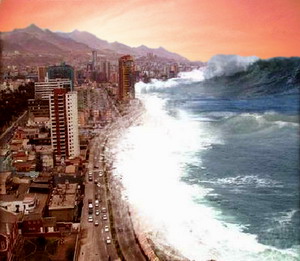 Gigantic waves caused by a 15 km dwarf planet impacting the North Atlantic Ocean will sweep across the Norwegian, North, and Barents Seas, inundating nearly all of Europe with water, crushed ice, gravel, sand, and silt.
The kinetic energy of the first surge will be so immense that massive boulders weighing tens of tons will be transported from Scandinavia to Estonia, Latvia, Lithuania, Poland, and northern Germany, as has occurred previously in Earth's history.
Water will submerge land areas below approximately 100 meters above sea level for extended periods. The fate of Northern Europe will also befall the eastern coast of the US.
The ruins of abandoned cities – New York, Philadelphia, Jacksonville, Washington, Boston, Miami, Halifax, New Orleans, and others destroyed by the Great Earthquake and washed away by ocean waves – will be erased from the face of the Earth. Hudson Bay will likely temporarily connect with the Gulf of St. Lawrence and the Gulf of Mexico.
The US West Coast will also suffer severe impact damage: Los Angeles, Oakland, San Diego, San Francisco, and other cities will highly likely be completely destroyed and submerged by seawater.
According to computer modeling, the largest human casualties are expected in Indonesia, Japan, China, and India. However, dozens of mega-tsunamis caused by land or marine asteroid impacts are far from the end of this hydrospheric disaster.
6.2.2. Territories Affected by Flooding
Submarine volcanic eruptions triggered by the powerful impact, landslides and earthquakes with moment magnitudes exceeding 6, tectonic deformation of the ocean floor, large-scale oscillations of ocean levels and atmospheric pressure, massive subaerial slope failures – such as the collapse of the western flank of the Cumbre Vieja volcano in the Canary Islands—as well as glacier displacement and collapse, would generate tsunamis and megatsunamis that would strike one after another across ALL major bodies of water.
These gravitational waves would inundate nearly the ENTIRE planet, much as occurred during the global Flood around 9900 BC. For various reasons, tsunamis would continue to occur repeatedly over a period of approximately five months. In the Northern Hemisphere, with the exception of mountainous regions, Canada, the United States (including Alaska), Mexico, and the islands between North and South America would remain flooded for nearly a year. In the Southern Hemisphere, Venezuela, Colombia, Guyana, and all the countries of Central America would also be inundated.
On the African continent, Western Sahara, Mauritania, Senegal, Mali, Nigeria, Niger, Libya, Egypt, and Sudan would be flooded. In the Persian Gulf region, Yemen, Oman, the United Arab Emirates, Kuwait, Qatar, Bahrain, and Iraq would be affected.
In Southeast Asia, flooding would extend across India, Pakistan, Thailand, Cambodia, eastern China, South Korea, and part of North Korea. Numerous islands would disappear beneath the water, including those of the Malay Archipelago, as well as Taiwan and the Japanese Islands.
In Europe, Iceland, Great Britain, Ireland, Norway, Sweden, Finland, France, Belgium, the Netherlands, Germany, Denmark, Portugal, Spain, Italy, Poland, Estonia, Latvia, Lithuania, Belarus, Ukraine (with Crimea becoming a small island), Romania, Hungary, Moldova, parts of Bulgaria and Greece, and all islands of the Mediterranean and Aegean Seas would be affected.
In northern Asia, water mixed with fragmented ice would inundate the islands of the Arctic Ocean, the East European Plain, the West Siberian Lowland, the basins of the Lena, Indigirka, and Kolyma rivers, Chukotka, the Anadyr River basin, the Kamchatka Peninsula, and Sakhalin Island. In Central Asia, flooding would affect territories of Azerbaijan, Kazakhstan, Turkmenistan, and Uzbekistan.
The volume of water would be so great that the northern seas – the Norwegian, White, North, Barents, Kara, and Laptev Seas – would likely become connected with the inland continental seas: the Mediterranean, Red, Black, Azov, Caspian, and the remnants of the Aral Sea. Water levels would rise substantially, particularly in the Caspian, Aral, and Azov Seas, whose surface areas would expand significantly.
In the Southern Hemisphere, apart from mountainous regions, temporary inundation would affect Australia, all islands between the Indian and Pacific Oceans, the coasts of the African continent, Madagascar, Antarctica, and the South American countries of Argentina, Uruguay, Paraguay, Brazil, Bolivia, and Peru. Tele-tsunamis would sweep across all islands of the World Ocean: many would change position, some would disappear, while new islands would emerge.
Approximately five months later, the water covering the continents would begin to return more rapidly to the oceans and seas, carving canyons and deep depressions into the land over a period of about seven months. Countless torrential saline rivers would carry fertile soil, sand, rocks, uprooted trees, the bodies of the dead, and debris. Vast expanses of mud would remain where temporary inland “seas” had dried up. Yet not all of the water would return to the oceans; new inland saline water bodies would remain on the continents.
The Bible describes a similar global cataclysm that occurred in the distant past, most likely around 12,000 years ago. This event is identified as the worldwide Flood, which, according to the author's conceptual reconstruction, was most likely caused by the collision of the Earth with a planetoid or a large fragment thereof that impacted the region of Greenland.
6.3. Boiling and Burning Seas
Powerful thermal explosions generated by cosmic bodies impacting the World Ocean, eruptions of dozens of submarine volcanoes, and the combustion of released gases would cause seawater to boil within affected zones up to 500 km or more in diameter. As a result, ocean and sea temperatures would increase significantly, even beyond the immediate areas of impact, volcanic activity, or gas combustion.
Furthermore, rifting-induced deformation of the ocean floor, including seismic fractures extending 1,000–1,500 km in length and up to 100 km in width, would allow seawater to penetrate toward the Mohorovičić discontinuity between the Earth's crust and the upper mantle, where temperatures are estimated to be approximately 2,500°C. The water would be heated and, upon returning to the surface, would boil as a result of pressure reduction.
As a consequence of the factors described above, the temperatures of the oceans and seas would rise substantially. According to marine hydrologists, increased bottom-water temperatures in tectonically active regions would trigger the rapid and irreversible dissociation of metastable minerals known as gas hydrates – crystalline non-stoichiometric compounds of water and gases such as methane, hydrogen sulfide, and carbon dioxide.
These hydrates formed long ago under specific thermobaric conditions within sediments beneath the seafloor and within permafrost regions of the continents. Rising temperatures and decreasing pressure would release enormous volumes of gas from these hydrate deposits, which outwardly resemble compacted snow. One cubic centimeter of gas hydrate can contain up to 180 см³ of pure gas, while global hydrocarbon reserves in hydrate form are estimated to range from 2.8 × 10¹⁵ m³ to 8.5 × 10¹⁸ m³.
The explosive release of gases from bottom sediments would result in:
a) bubbling and foaming of the water surface;
b) massive emissions of gases into the atmosphere;
c) combustion of methane, ethane, and hydrogen sulfide above the surface of the hydrosphere, specifically:
- at the epicenters of asteroid impacts and submarine volcanic eruptions;
- along tectonic seismic fractures of the ocean floor; in areas affected by submarine earthquakes and large-scale underwater landslides.
Does the Bible contain any reference to the extraordinary phenomena of burning and boiling seas? Does it identify the causes of such remarkable processes? According to this interpretation, it does. For example, the Leviathan described in the Book of Job possesses the following characteristic: «He makes the deep boil like a pot; he makes the sea like a pot of ointment» (Job 41:31).
This mythological Leviathan is attributed another striking property: «Behind him he leaves a shining wake» (41:32, а), which may be interpreted as burning gas extending above long seismic fractures of the ocean floor. The same verse continues: «one would think the deep to be white-haired» (41:32, b), rendered in some translations as "covered in white foam."
The prophet Amos was shown a vision of fire consuming an immense volume of seawater: «behold, the Lord GOD was calling for a judgment by fire, and it devoured (burned) the great deep» (Amos 7:4). In reality, as a consequence of a cosmic catastrophe, the World Ocean would NOT completely evaporate. However, for various reasons, its level could temporarily decline by several meters.
6.4. Volcanic Eruptions
The displacement of lithospheric plates caused by the seismic shock generated by the thermal explosion accompanying the collision of our planet with a massive asteroid will lead not only to widespread earthquakes but also to other extraordinary geophysical phenomena. These will result from the sliding of tectonic plates over the asthenosphere along major transform fault systems within the Earth's crust.
The movement of enormous masses of rock will increase pressure and temperature within the Earth's upper mantle. Consequently, within only a few hours after the impact, hundreds of dormant volcanoes may awaken out of the approximately 1,800 potentially active volcanoes on Earth (of which 50 to 70 erupt annually). This will include volcanic structures associated with the submarine Arctic ridges of Lomonosov, Gakkel, and Alpha, as well as numerous cone-shaped volcanic edifices situated along the boundaries of the eight major tectonic plates, dozens of intermediate plates, and many smaller crustal blocks.
Volcanic eruptions will be accompanied by the fallout of ash, lapilli, and ballistic bombs, as well as by lava flows, mudflows, pyroclastic flows, and avalanches. Particularly hazardous are the effusive volcanic systems of the Pacific Ring of Fire, where more than 80 percent of the Earth's total seismic energy is released. An exceptionally large number of eruptions, both submarine and subaerial, are expected in the region between the Indian and Pacific Oceans, especially throughout the Malay Archipelago.
These include Krakatau, Merapi, Dieng, Tengger, Tangkuban Perahu, Raung, Kelud, Galunggung, and many other volcanoes on Java; Tambora, Batur, Rinjani, Agung, and others on the Lesser Sunda Islands; Toba, Ranau, Suoh, Dempo, Kaba, and numerous others on Sumatra; Serua, Teon, Gunungapi Wetar, Banda Api, and others in the Banda Sea; Colo, Awu, Ruang, Tangkoko-Duasudara, and others on Sulawesi and the Sangihe Islands; Gamkonora, Makian, Ibu, Gamalama, Dukono, and others on Halmahera; Pinatubo, Mayon, Taal, Kanlaon, Bulusan, Smith, and others in the Philippine Islands; Manam, Ritter, Sakar, Bam, Karkar, and many others on New Guinea.
The volcanoes of the Caribbean Sea will likewise remain dangerous: Mount Pelée, La Soufrière, Soufrière Hills, Qualibou, Morne Trois Pitons, and others. The most active volcanic centers are expected to be those in Iceland, the Hawaiian Islands, the Philippines, Japan, the Antilles, the Aleutian Islands, the Kuril Islands, and the Kamchatka Peninsula. Alongside them, Krakatau, Tambora, Kerinci, Merapi, and Kelud (Indonesia); Etna, Vesuvius, Stromboli, and Vulcano (Italy); Teide and the La Garrotxa volcanic field (Spain); Nevado del Ruiz, Galeras, Huila, Puracé, and others (Colombia) may also become highly active.
Additional hazardous volcanoes include Popocatépetl, Colima, El Chichón, Bárcena, and many others in Mexico; Tungurahua, Reventador, Cotopaxi, and Sangay (Ecuador); Chaitén and San Pedro (Chile); Llullaillaco (Chile–Argentina); Aconcagua (Argentina); El Misti (Peru); Nyiragongo (Democratic Republic of the Congo); Mount Cameroon (Cameroon); Augustine, Katmai, Novarupta, Redoubt, Akutan Island, and others in Alaska; Hoodoo Mountain, Edziza, Meager, and Garibaldi (Canada); Mount St. Helens, Mount Rainier, Long Valley, Lassen Peak, and many others in the United States.
Also considered hazardous are San Miguel, Izalco, and San Salvador in El Salvador; La Yeguada and Barú in Panama; Arenal, Rincón de la Vieja, Turrialba, and others in Costa Rica; Momotombo, Cerro Negro, San Cristóbal, and others in Nicaragua; Santa María, Pacaya, Fuego, and many others in Guatemala; Whakaari (White Island) and Taupō in New Zealand; Ulawun and Manam in New Guinea; Piton de la Fournaise on Réunion Island; Yasur on Tanna Island; Mawson Peak, Big Ben, Kinrara, Barrine, and Eacham in Australia; and Erebus, Deception, Hudson, Berlin, Melbourne, and many other volcanoes of Antarctica.
6.4.1. Volcanic Crater Activity
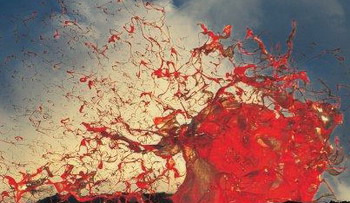 Probably, the vision of one of these major volcanic eruptions, after the fall of the "stars" from the sky, was discovered John the Theologian. He argues that by "Fire", "Smoke" and "sulfur" die in three (!) Inhabitants of the earth (Revelation 9:18).
Indeed, the zoomorphic-anthropomorphic locusts described by the prophet closely resemble the products of volcanic eruptions (Fig. 6).
Explosive eruptions consist of incandescent gases—including sulfur oxides, hydrogen sulfide, carbon dioxide, carbon monoxide, and others – as well as tephra (ash, lapilli, and ballistic volcanic bombs). This material is ejected laterally or, less commonly, vertically upward, after which it collapses back toward the slopes of the volcano.
The settling cloud of ash, soot, pulverized pumice, and volcanic gases generates a scorching volcanic cloud known as a pyroclastic flow, with temperatures ranging from 100°C to 800°C. Moving at velocities of 80 to 700 km/h, such an avalanche incinerates everything in its path for tens of kilometers.
In reality, people will perish not from lava but, as John foresaw, from "fire" (burns), from "smoke" (suffocation caused by ash and gases), and from "sulfur" (poisoning by sulfur-bearing gases). A portion of the sulfur oxides contained in volcanic emissions is oxidized in the atmosphere and, reacting with atmospheric water vapor, forms sulfuric acid, which subsequently falls as prolonged acid rain, much as occurred following the formation of the Chicxulub crater.
Climatologists maintain that if the strength of a volcanic eruption exceeds VEI 6 on the Volcanic Explosivity Index (whose maximum value is VEI 8, corresponding to an ejecta volume exceeding 1,000 km³ and an ash column rising above 25 km), noticeable global cooling will occur. A comparable example is the 1991 eruption of Mount Pinatubo on the Philippine island of Luzon (VEI ≈ 6), which lowered the Earth's average atmospheric temperature by approximately 0.5°C.
An even greater decline in global temperature—estimated at between 0.7°C and 2.5°C according to various studies—followed the 1815 eruption of Mount Tambora. The eruption discharged approximately 150–180 km³ of material with a total mass of about 1.4 × 10¹⁴ kg, causing 1816 to become known as the "Year Without a Summer." Ash and gases injected to altitudes of 20–40 km (the so-called eruption column) dispersed through the atmosphere and sharply reduced its transparency to incoming solar radiation, resulting in significant cooling.
Gradually, through coagulation, the mass of aerosol particles increases, causing them to settle back to the Earth's surface and blanket the land with deposits several meters thick. The 1912 eruption of Mount Katmai in Alaska deposited tephra layers up to 3 meters thick even at distances of 160 km from the crater. The eruption of Tambora resulted in ashfall at distances of at least 1,300 km from the volcano.
6.4.2. Supervolcano Eruptions
Supervolcanoes pose a particularly serious hazard. Approximately twenty such formations have been officially identified, and all are classified by volcanologists as potentially active. A supervolcano is a vast, relatively flat geological structure (VEI = 8) situated above enormous magma reservoirs. Unlike ordinary volcanoes, it does not erupt in the conventional sense but rather explodes catastrophically. Such an explosion could be triggered by the seismic shock generated by Earth's collision with a dwarf planet.
What would the consequences be? According to physical models and mathematical simulations, following the eruption of the Toba supervolcano (VEI = 8) on the island of Sumatra approximately 73,000 years ago, the Sun was obscured by atmospheric dust for about six months (roughly 3,000 km³ of ash were ejected into the atmosphere). Acid rain persisted for approximately six years because up to three billion tonnes of sulfur dioxide were released. Air temperatures declined by about 11°C (according to some estimates, even more), leading to a prolonged period of global cooling that lasted for decades.
In terms of energy release, supervolcanoes exceed even the most powerful eruptions or explosions of ordinary volcanoes by thousands of times (10¹⁹–10²⁰ J). This includes volcanoes as powerful as Tambora on Sumbawa Island in Indonesia (1815 eruption) and Krakatau, located between Java and Sumatra (1883 eruption).
The best-known supervolcano that could potentially become active following an asteroid impact in the Canadian Shield is located within Yellowstone National Park in the United States (Wyoming, Montana, and Idaho). Its gigantic caldera, covering approximately 3,825 km² – a depression roughly 72 × 55 km in size – can only be fully appreciated from the air or photographed from space.
The magnitude of Yellowstone's eruption approximately 600,000 years ago is estimated at about VEI 8, with an ejecta volume of approximately 2,450 km³. Numerous eruptions have occurred there over the past 17 million years, and some volcanologists consider another major eruption possible in the foreseeable future. Earthquakes associated with caldera-forming eruptions can be felt over vast distances and may trigger the activation of other volcanoes, including submarine volcanoes, which in turn could generate powerful tsunamis and teletsunamis.
In addition to Yellowstone, other particularly hazardous supervolcanoes include the Long Valley Caldera (California), the Valles Caldera (New Mexico), the La Garita Caldera (Colorado), the Misema Caldera (Ontario and Quebec, Canada), Aira/Sakurajima (Japan), Toba and Merapi (Indonesia), Taupō (New Zealand), Cerro Galán (Argentina), La Pacana Caldera (Chile), and the Campi Flegrei volcanic field (Italy).
A supervolcano poses a threat to populations across an immense region, potentially extending over a diameter of approximately 2,500 km. Yellowstone, for example, could potentially affect almost the entire territory of the United States. The danger arises not only from the colossal explosions themselves, magma ejected to altitudes of up to 50 km, continent-scale earthquakes, lava flows involving thousands of cubic kilometres of material, atmospheric plumes, and hurricane-force pyroclastic density currents, but also from the prolonged period following the end of the catastrophe.
Such an exceptionally powerful volcano is capable of ejecting up to 2,500 km³ of material into the atmosphere to heights of 30–40 km or more. For comparison, Tambora expelled no more than 180 km³ of material to an altitude of approximately 43 km, causing the deaths of about 100,000 people. Krakatau ejected approximately 20 km³ to heights of up to 30 km, and the death toll exceeded 36,000.
Large-scale eruptions may contain up to 100 km³ of extremely fine volcanic glass dust capable of remaining suspended in the atmosphere for approximately four years. Such dust, composed of sharp, hard micro- and nanoparticles, can enter the lungs and circulatory systems of humans and animals, causing severe illnesses and often death.
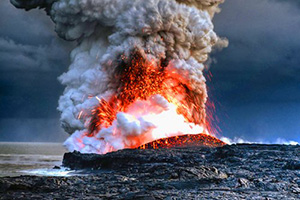
Following a supervolcanic eruption (Fig. 7), widespread acid rain will destroy vegetation. Ash falls so dense that visibility may be reduced to only a few tens of centimetres will blanket the ground with layers of volcanic ash, soot, and pumice pulverized into fine dust. Even at considerable distances from volcanic centres, drifts of pyroclastic material 4–5 m high may accumulate.
For many months, sunlight will be dimmed by smog and coarse particulate aerosols enveloping the globe, and the planet will experience several years of severe cooling.
Thus, according to scientific estimates, impact-triggered eruptions of the Yellowstone Caldera – which could continue for several days – may be capable of destroying virtually all life within a region up to 2,500 km in diameter and covering a large portion of the United States with volcanic deposits averaging approximately 1 m in thickness.
This could lead to a decrease in tropospheric temperatures of approximately 20°C, as well as extensive glaciation of territories located north of 50° N latitude. The resulting global famine could cause the deaths of more than two billion people during the first months following the catastrophe.
According to data from the World Meteorological Organization and assessments by certain specialists in climatology and volcanology, the critical accumulation of enormous quantities of volcanic ash, mineral dust, and gases in the atmosphere could have devastating consequences for modern civilization if more than 23,000 km³ of such ejecta were injected into the atmosphere.
4.6. Fires
The collision of massive celestial bodies with Earth, the re-entry of superheated impact ejecta from the atmosphere, atmospheric plumes, volcanic eruptions, supervolcanic explosions, and lightning strikes will trigger extensive forest, grassland, and peat fires. As stated in the prophecy of Zephaniah: «for in the fire of my jealousy all the earth shall be consumed» (Zephaniah 3:8).
The Book of Malachi refers to this period as «the day is coming, burning like an oven» (Malachi 4:1). This gigantic "furnace" will release billions of tonnes of ash, soot, water vapor, carbon monoxide, carbon dioxide, nitrogen oxides, and sulfur oxides. Through oxidation and reactions with atmospheric water vapor and hydroxyl radicals, nitrogen and sulfur oxides will form nitric and sulfuric acids, whose condensed vapors will fall as torrential acid rain.
The prophet Joel likewise speaks of the great and terrible Day of the Lord and His vast army: «Fire devours before them, and behind them a flame burns. The land is like the garden of Eden before them, but behind them a desolate wilderness, and nothing escapes them» (Joel 2:3).
This is why the Apostle John sees fire descending from heaven and consuming all the grass and a third of the trees. Joel also warns that on the Day of the Lord, fire will consume the pastures and burn all the trees of the field. According to these biblical images, however, not only grass, shrubs, and forests will burn, but also substances that under ordinary conditions do NOT sustain combustion.
Thus, the prophet Isaiah foresees fires so intense that rivers and even the land itself ignite: «And the streams of Edom shall be turned into pitch, and her soil into sulfur; her land shall become burning pitch» (Isaiah 34:9, ESV). According to Isaiah, mountains will burn like brushwood. Moreover, the atmosphere itself will ignite through the formation of fire whirls – fire tornadoes and fire-induced vortices reaching diameters of several kilometers, heights of 3–10 km, and translational speeds of 30–70 km/h.
A continuous sea of fire may develop during supervolcanic explosions, certain types of volcanic eruptions, and large-scale fires in regions containing high concentrations of combustible gases, particularly methane, ethane, propane, and hydrogen sulfide released from gas hydrates and geological formations. Owing to the extremely high temperatures within fire tornadoes (up to 1,000°C), everything capable of burning within the vortex – or drawn into it by the powerful thermobaric effect – will be consumed.
Aluminum structures will melt, while steel will lose its mechanical strength and undergo severe deformation. If the velocity of such a vertical fire vortex exceeds approximately 70 km/h, it may evolve into a firestorm – a tilted or horizontal front of flames, smoke, and superheated gases advancing downwind at speeds of up to 200 km/h.
The prophet Amos saw a firestorm that «devoured (burned) the great deep and was eating up the land» (Amos 7:4). In the New Testament, the future fiery catastrophe is likewise foretold by the Lord Jesus Christ: «Just as the weeds (more precisely: "rip out") are gathered and burned with fire, so will it be at the end of the age» (Matthew 13:40).
His disciple, the Apostle Peter, declares that the surface of the planet will be consumed by fire from superheated and disintegrating heavenly bodies: «But the day of the Lord will come like a thief [at night], and then the heavens will pass away with a roar, and the heavenly bodies will be burned up and dissolved, and the earth and the works that are done on it will be exposed» (2 Peter 3:10, more precisely: "and the earth and everything on it will be burned up").
In the event of a collision between Earth and a large asteroid, not only widespread fires may occur, but also extreme atmospheric phenomena, among which hypercanes may potentially develop.
6.6. Hypercanes
Widespread wildfires will advance rapidly amid a deafening roar, driven by hurricanes of unprecedented destructive power, with wind speeds ranging from 100–350 km/h to 500–800 km/h according to certain theoretical models. In the latter case, such an exceptionally intense wind system would be classified as a hypercane – a super-hurricane extending over an area comparable to that of a continent and exhibiting the maximum destructive force corresponding to Force 12 on the Beaufort scale.
The precise characteristics of the predicted hypercanes remain uncertain because no such phenomena have been observed during the modern era. Nevertheless, tropical meteorologists reasonably suggest that hypercanes could form when sea-surface temperatures exceed 50°C, analogous to modern tropical cyclones (typhoons), which generally require ocean temperatures above 26.8°C for development.
Typhoons with wind speeds reaching up to 400 km/h, severe storms (60–100 km/h), and tornadoes may develop as a result of tropical and extratropical cyclones. Dozens of cyclonic systems (typhoons) could form simultaneously over the World Ocean as seawater becomes heated to depths of tens of meters, creating vast regions of elevated sea-surface temperatures (greater than 26.8°C but below 50°C). Above these regions, enormous masses of hot, moisture-laden air would rise and rotate in spiral circulation patterns (Fig. 8, upper left).
According to various estimates, disaster zones associated with typhoons and hypercanes, ranging in diameter from approximately 3,000 km to more than 10,000 km, could develop both near the equator and above asteroid impact sites, tectonic fractures in the ocean floor, newly awakened submarine volcanoes, and regions where methane, ethane, and hydrogen sulfide released from marine gas hydrates are burning. During the prolonged existence of such powerful wind systems, they could even generate localized rises in sea level, while waves exceeding 15 meters in height would batter shallow coastal regions.
Hurricanes, typhoons, and hypercanes would loft hundreds of billions of tonnes of dust and sand high into the homosphere from the Sahara, the Arabian deserts, the Kalahari Desert in Africa, Patagonia in South America, the deserts of Australia, Central Asia, and North America, producing massive dust and sand storms.
The principal source of kinetic energy for such large-scale wind systems would be the latent heat released due to the avalanche-like condensation of vast quantities of water vapor contained in rising masses of hot, humid air as they ascend into the colder upper layers of the atmosphere. A sharp drop in local atmospheric pressure would occur, generating powerful ascending warm air currents and descending cold air currents. These turbulent flows would produce a roar comparable to that of a jet aircraft during takeoff. 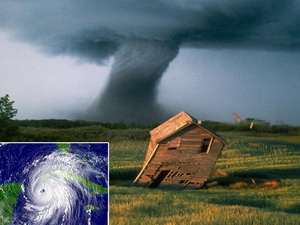 In one of the Psalms, Asaph prophesies concerning the last days of this age as follows: «Our God comes; he does not keep silence; before him is a devouring fire, around him a mighty tempest.» (Psalm 50:3).
King David points to the cause of the consuming fire and scorching wind – a shower of meteoric bodies, described as «fire and sulfur and a scorching wind» (Psalm 11:6).
Describing God's visitation of the earth, Isaiah speaks of thunder, earthquake, the flame of a devouring fire, storm, and "whirlwind" (Isaiah 29:6). The emergence of the latter is also foretold by Jeremiah and Nahum.
Under such winds as hurricanes, vertical whirlwinds, and tornadoes, air masses move translationally at speeds of 20–60 km/h (and up to 800 km/h in hypercanes) while simultaneously rotating around an invisible axis.
The funnel-shaped vortex column (Fig. 8, center), with a lower-section diameter reaching several kilometers, consists of two laminar flows. The inner flow rises upward at speeds of up to 300 km/h, while the outer flow—composed of air, water, sand, stones, ice fragments, building debris, and other material—spirals around it at speeds of 100–600 km/h. These are the so-called "violent tornadoes" of the highest F5 category on the Fujita scale.
Hundreds of ordinary and fire-generated vertical vortices will affect a much smaller area than hypercanes, hurricanes, and severe storms; nevertheless, they will cause destruction of comparable intensity. The energy of even a typical medium-sized tornado, with a rotational velocity of 250 km/h and a funnel diameter of 2 km, is comparable to the energy released by the detonation of a one-megaton nuclear bomb. The ruins of cities devastated by earthquakes will be scattered by powerful winds, while tsunamis will inundate the wreckage with seawater and bury it beneath layers of silt, mud, and sand.
6.7. The disappearance of the sky
The Bible predicts meteorological extreme events of the Day of the Lord in the form of dust and sand storms (the so-called “khamsin”), tornadoes, squalls, and whirlwinds. At the same time, it foretells something even more extraordinary – namely, the folding up of the firmament of the sky!
Thus Isaiah states: «All the host of heaven shall rot away, and the skies roll up like a scroll. All their host shall fall, as leaves fall from the vine…» (Isaiah 34:4). The Apostle John sees this event as already accomplished:
«The stars of the sky fell to the earth … The sky vanished like a scroll that is being rolled up» (Revelation 6:13–14, (in one of the translations: " split and curdled"). The Apostle Peter likewise proclaims that «the heavens will pass away with a roar» (2 Peter 3:10; in other translations, "will disappear"). But is such a thing, in principle, possible, or is there an error here?
To properly answer this question, one should consider the following. All three prophecies concerning the disappearance of the dome of the sky by its "rolling up" are associated with the falling of "stars" (Isaiah, John) – in scientific terms, meteors – or with the «burned up and dissolved» (Peter), i.e., the disintegration of larger cosmic bodies.
When an asteroid falls into the World Ocean, it is highly likely to generate a hypercane of continental scale, which will sequentially strike one country after another. This is warned of by the prophet Jeremiah: «Behold, disaster is going forth from nation to nation, fand a great tempest is stirring gfrom the farthest parts of the earth!» (Jeremiah 25:32), and «a whirling tempest; it will burst upon the head of the wicked.» (30:23).
This hypercane will "roll up" the sky like a scroll; following such a vast atmospheric vortex, it will "pass away," disappearing behind a veil of dust and ash. For half a year, the sun, moon, stars, and clouds will be completely invisible. The ruins of abandoned cities, temporarily flooded by seawater, will be covered with dust, ash, sand, crushed pumice, and soil.
After the end of the intense ash fallout, the solar disk will again become visible, but its light will no longer dazzle the eyes due to suspended atmospheric dust. The usual blue color of the sky – caused by molecular Rayleigh scattering of the short-wavelength (0.38–0.52 μm) portion of sunlight – will change. It will instead appear red due to aerosol scattering on particles of smoke, dust, sulfur-, oxygen-, and nitrogen-containing compounds, etc
Since particle diameters (0.1 μm–100 microns) exceed the scale of gas molecular clusters and are comparable to the wavelength of red light (0.76 μm), the optical properties of the Earth’s atmosphere will change. As a result, all celestial bodies will appear red: the Moon and the "sword of Yahweh" in Isaiah’s vision; the moon, the great dragon, and the scarlet beast in John’s Revelation.
6.8. Global Flood
A natural disaster analogous to the Flood in the days of Noah (approximately 9,900 BCE) would be caused by:
(1) ocean waves generated by earthquakes, typhoons, tropical cyclones, and storms;
(2) heavy torrential rainfall;
(3) river flooding due to obstructed drainage caused by ice, landslides, rockfalls, avalanches, and slope wash;
(4) dam failures; and
(5) rapid melting of snow and ice.
All of the above physical factors of a global flood would be supplemented by additional processes indicated by modeling of phenomena associated with the formation of the Chicxulub crater. Thus, as a result of asteroid impacts into the World Ocean, eruptions of several hundred terrestrial and dozens of submarine volcanoes, and the evaporation and boiling of water, as well as its transport by hypercanes, the moisture capacity of the strongly heated atmosphere, according to the author’s calculations, would increase more than 200-fold.
Therefore, as the atmosphere begins to cool through radiative heat loss into space, relative humidity would rise (reaching the dew point), triggering avalanche-like condensation (coalescence) of water vapor. This would result in widespread, continuous hot acidic precipitation (pH ≈ 4) in the form of heavy downpours of black, white, and red rain.
Hot – due to the high condensation temperature (above 50°C) resulting from extreme overheating of the troposphere. Black – to ash, soot, and volcanic dust; white – due to mineral dust from carbonate rocks; red – due to iron oxides present in meteorites in free form. Acidic – primarily due to sulfur and nitrogen oxides; sources of these oxides would include volcanic emissions, combustion of hydrogen sulfide, explosions caused by meteorite impacts, and wildfires, among others.
Some of these oxides, reacting with water vapor, would form sulfuric and nitric acids, contaminating water and soil. Due to heavy atmospheric dust loading, the process of photosynthesis would be significantly inhibited. All of this would lead to damage to the respiratory systems of organisms, contamination of drinking water, and deterioration of soil fertility.
According to the biblical narrative of the Flood, such widespread rainfall in complete darkness would likely also last for about 40 days – the time required for the troposphere to cool.
This unusually long duration of rainfall is explained by continuous condensation accompanying the decrease in air temperature. Despite the ongoing reduction in absolute humidity, the air would remain in a state of full saturation with water vapor throughout the entire 40-day period.
The prophet Ezekiel, warning about judgment in the last days, mentions an unusual " ltorrential rains ," along with hailstones, fire, and sulfur (Ezekiel 38:22). Isaiah likewise speaks of precipitation, for which the "windows of heaven" are opened, together with the shaking of the foundations of the earth. He calls this deluge a "flood" (in other translations: "great rain"), listing other judgments: devouring fire, storm, and hail.
6.9. Long-Term Consequences of the Catastrophe
The impending hydrological emergency in Israel is described by the Apostle John as an overflowing river—a blood-red torrent approximately 1.5 m high and 300 km long. Torrential rains during the global 40-day darkness will further elevate water levels remaining on continents after the onslaught of unprecedented tsunamis that submerged vast land areas.
Warning of the last days of this wicked generation, the Lord Jesus Christ compares the global calamity to the days of Noah: «Just as it was in the days of Noah, so will it be in the days of the Son of Man ... the flood came and destroyed them all» (Luke 17:26–27).
Torrential water flows, particularly in hilly and mountainous regions, possess immense destructive power—destroying dams, levees, bridges, roads, trees, buildings, and industrial facilities, threatening human life.
After 5 months, land waters will begin draining into seas and oceans, cutting deep channels into the earth with rapid currents. It will take at least 12 months post-cataclysm for inundated regions to dry out, as in the days of Noah. However, new inland seas will remain inside continents, and pre-existing inland seas will expand significantly.
Despite the wash-out of ash, mineral dust, soot (black carbon), and coarse particles from the troposphere by heavy downpours, a dense aerosol shield surrounding the Earth will persist, blocking solar rays. Consequently, following initial extreme heating of the atmosphere and landmasses, a gradual global cooling will begin 6–7 months post-impact, coinciding with the onset of winter in the Northern Hemisphere.
An "asteroid winter" will set in approximately 1.5 years after the cataclysm. Global temperatures will drop by 15 оС ... 20 оС or more (the average annual global surface temperature is approximately +15 оС). In inland regions of North America and Eurasia, temperatures will drop by 20–30 оС. Even in "warm" latitudes, summer temperatures will remain below 0 оС.
Roughly 3 years post-impact, global dimming will subside due to aerosol clearance via coagulation and precipitation of microparticles. Gradually, surface heating from solar radiation and greenhouse forcing will resume, initiating a slow temperature recovery.
The consequences of the cataclysm will be felt for decades, governed by residual atmospheric aerosols (sulfates), greenhouse gas concentrations, ocean cooling, altered currents, hydrological cycles, and ice sheet dynamics.
It can already be foreseen that supersonic shockwaves, mega-earthquakes, volcanic eruptions, supervolcano explosions, tsunamis, hypercanes, firestorms, dense ashfalls, acid rain, and floods will cause the greatest destruction in: Canada, the US, Iceland, Great Britain, Ireland; Mexico, Cuba, Venezuela, Colombia; Argentina, Uruguay, Chile, Brazil; Indonesia, the Philippines, Japan, Australia, and several other countries.
Living in Canada will become impossible—a nation partially destroyed by the thermal explosion in the Canadian Arctic Archipelago, devastated by tsunamis, covered in ash, and locked in ice. Survival will be severely compromised across most US territory following global earthquakes, marine surges, and supervolcanic eruptions at Yellowstone, Long Valley Caldera, and likely Valles and La Garita Calderas. Climate conditions will become substantially colder, particularly in northern states.