«Tell us, when will these things be, and what will be
the sign of your coming and of the end of the age?»
(Matthew 24:3, ESV)
«Then will appear in heaven the sign of the Son of
Man, and then all the tribes of the earth will mourn,
and they will see the Son of Man coming on the
clouds of heaven with power and great glory.»
(Matthew 24:30, ESV)
«You also, be patient. Establish your hearts, for the coming of the Lord is at hand.» (James 5:8). Here, James uses the word “παρουσία,” which in the New Testament has become a technical term referring to the future coming of Christ.
The impatient Christians in Thessalonica believed that the Day of the Lord (the period of eschatological judgments) had already come (2 Thessalonians 2:1-2). They were mistaken, failing to understand that His triumphant return is historically preceded by: the loss of Jewish statehood, the dispersion, and then the reunification of the Israeli people (Genesis 49:10, Jeremiah 31:10, Deuteronomy 30:3–5), world wars, famines, and epidemics (Matthew 24:6, 7).
Although in 2 Thessalonians 2:1–2 Paul emphasizes the immediate precursors to the Day of the Lord, other books of Scripture reveal a broader historical sequence of events that are to precede Christ’s return.
Undoubtedly, God will announce such an epoch-making event (Isaiah 42:9, Amos 3:7), Elijah will appear (Malachi 4:5), there will be solar and lunar eclipses (Joel 2:31), a sign will appear in the sky, and Jesus Christ will return with power and great glory (Matthew 24:30).
Not only during the era of the early apostolic church, but even today, this mistake made by the Thessalonians often occurs. One of the main reasons for this interpretation is that believers – such as adherents of preterism – fail to distinguish between historical biblical prophecies concerning the destruction of the Jerusalem Temple in A.D. 70 and eschatological prophecies.
The term "eschatology" derives from the Greek words ‘eschatos’ (last, final) and "logos" (teaching). In theology and philosophy, eschatology is "the branch of theology devoted to the study of the last days, the end of the world, and the fate of individuals and the world at that time" [L.36, p. 1417].
1. A Prophetic Perspective
Second, the Teacher himself followed the principle of the Old Testament prophets (Hebrew: נָבִיא, pronounced “navi”), who often grouped situations not in chronological order but thematically [L.1]. Third, in the New Testament, as in the Tanakh, we encounter a "prophetic perspective" [L.2, p. 85] or "condensed perspective" [L.3, p. 472, "progressive fulfillment of prophecies" [L.4, p. 14], "compressed time" [L.30, pp. 178, 429].
"It is very characteristic of biblical prophecy to combine two future events that are in fact separated by a long interval of time" [Ref. 39, p. 121], and "the Bible generally follows the principle of bringing together events that are actually far apart in time" [Ref. 29, p. 586].
For example, in Isaiah's prophecies, the ministry of the Messiah carried out during His two comings is presented without any interval of time separating them (Isaiah 9:6–7; 61:1–2); the two events are not distinguished from one another [Ref. 30, p. 551]. The same pattern appears in Micah (Micah 5:2–4), Zechariah (Zechariah 9:9–10), and Malachi (Malachi 3:1–3).
Likewise, in Haggai's prophecy concerning the destiny of Israel, no millennium separates the construction of the Second Temple in Jerusalem from that of the future Third Temple (Haggai 2:2–9). Jeremiah's prophecies concerning the return of the Jews from the Babylonian captivity and the coming of the Messiah are likewise presented in close connection (Jeremiah 30:6–10, 18–24; chapter 31).
Ezekiel, Isaiah, and Jeremiah combine predictions concerning the Babylonian invasion with those of the eschatological Day of the Lord (Ezekiel 30:3–10; 32:2–15; Isaiah 13:1–16; Jeremiah 25:9–38). A similar pattern appears in Nahum's warnings concerning the visitation of Yahweh upon the land in the Day of Distress (Nahum, chapter 1) and the destruction of the Assyrian city of Nineveh (chapters 2–3).
In his apocalyptic vision, Daniel likewise combines the period of Seleucid rule—particularly that of Antiochus IV Epiphanes—with the final days of wrath and the end of the age (Daniel 8:1–26).
It is precisely this characteristic of biblical prophetic language that often creates difficulties in interpreting the eschatological chapters of the Gospels. This is also noted by the author of [Ref. 2, p. 85]: "For example, the destruction of Jerusalem in A.D. 70 and the day of judgment – the end of this age – are spoken of as though they were a single event, and we must bear this in mind when reading such chapters as Matthew 24–25, Mark 13, and Luke 21." (See also Refs. 4, pp. 15, 66; Ref. 5, p. 19.).
Nevertheless, as modern commentaries on Luke 21:7 point out, the Lord truly foretells different events: "He speaks of two entirely different events: the destruction of the Temple and the end of the world" [Ref. 1, p. 204]; they "... will take place in A.D. 70 and at the end of this age, on the day of judgment" [Ref. 2, p. 86].
"In presenting these events, Jesus followed the pattern of the Old Testament prophets, who described distant future events in the 'terms' and imagery of events belonging to the near future ..." [Ref. 12, p. 172]. Likewise, "prophecy is often fulfilled in two stages – during Christ's first coming and during His second coming" [Ref. 27, p. 937].
Exactly so. Between the siege of Jerusalem (Luke 21:20–24) and the days of fearful signs, despair, and distress (vv. 25–26), after which the Son of Man will come (vv. 27–28) and His kingdom will draw near (v. 31), the text itself indicates the existence of an unspecified interval of time. Jesus Himself speaks of this interval.
«Jerusalem will be trampled underfoot by the Gentiles, until the times of the Gentiles are fulfilled.» (Luke 21:24b). «And the gospel must first ("before the end comes," trans. [Ref. 35]) be proclaimed to all nations.» (Mark 13:10).
2. When Will the End Come?
They asked: «Tell us, when will these things be, and what will be the sign of your coming and of the end of the age?» (Matthew 24:3; "What will be the sign of Your return, and when will the end of the world come?" trans. [Ref. 26]; "What sign will indicate Your return and the end of the present world?" trans. [Ref. 37]).
In Matthew 24:3 and 24:30, the same Greek word σημεῖον (sēmeion) is used. It means "sign," "mark," or "token." In the New Testament, it denotes not merely an identifying sign but also a sign through which God reveals His purposes or confirms His intervention in history. For this reason, throughout this article the term sēmeion will generally be rendered as "sign," thereby preserving the consistency of biblical terminology.
In answer to the first question – concerning the time of the destruction of Beit Adonai and the capital – the Teacher did not reveal the exact date. Nevertheless, He pointed to the principal historical events and "made known to them all the signs of His coming" [Ref. 4, p. 51]. "But when you see Jerusalem surrounded by armies, then know that its desolation has come near" ("the time of its destruction is near," trans. [Refs. 37, 38])
"They will fall by the edge of the sword and be led captive among all nations (into various countries), and Jerusalem will be trampled underfoot by the Gentiles, until (that is, until the time when) the times of the Gentiles are fulfilled" (Luke 21:20–24; "until their time has come to an end," trans. [Refs. 35, 38]).
The author associates the completion of this part of the prophecy (Luke 21:24) with Jerusalem's becoming the one and indivisible capital of the State of Israel. This highly significant prediction of the Lord Jesus Christ contains at least three successive elements, or more precisely, three distinct parts: (1) the fall of Jerusalem; (2) the dispersion of the Jewish people among the nations; and (3) the completion of "the times of the Gentiles." This internal structure of the prophecy explains why its fulfillment extends over a prolonged period of history.
This is precisely what happened, at least with regard to the first part of the prophecy. In A.D. 70, during the First Jewish Revolt (A.D. 66–73), the Roman armies under Titus, the son of Emperor Vespasian, captured and destroyed Jerusalem—including the Temple—after a five-month siege. According to the testimony of Josephus, more than one million Jews perished, just as the Lord had foretold: "They will fall by the edge of the sword."
 After the suppression of the Second Jewish Revolt (A.D. 132–135), Emperor Hadrian founded the Roman colony of Aelia Capitolina upon the ruins of Jerusalem. The Jewish state ceased to exist, and the final dispersion of the children of Israel began [Ref. 7].
 Likewise, the second component of Jesus' prophecy concerning the national catastrophe of the Jewish people was fulfilled:"They will be led captive among all nations" (Luke 21:24b; "they will be taken as captives to other nations," trans. [Ref. 26]).
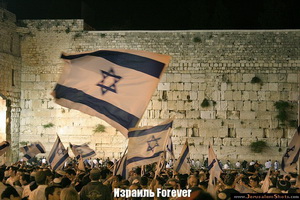
The third part of Christ's prediction was fulfilled only in 1980, when Jerusalem was proclaimed the one and indivisible capital of the State of Israel (Fig. 1). Since political control over the city had returned to the Jewish people, this may be understood as the prophetic sign marking the completion of "the times of the Gentiles."
3. The Sign of His Coming
Answering the disciples' second question, «Tell us, when will these things be, and what will be the sign of your coming ('How will we know about Your return and the end of this world?' trans. [Ref. 35]) and of the end of the age?» (Matthew 24:3), the Teacher described in detail the events that would precede the close of the present age and His return (Matthew 24; Mark 13; Luke 17; 21).
The appearance of the Savior will be preceded by numerous events, including wars, famines, epidemics, earthquakes, the persecution of Christians, the increase of wickedness, mutual hatred, the rise of false prophets, and the growing cold of love (Matthew 24:6–12).
The signs of «the end of the age» listed by Christ have been observable for almost two thousand years since Christ's ascension, indeed throughout nearly every period of history. For this reason, the Second Coming was expected by the church in Thessalonica in the A.D. 40s, by countless Christians around the year 1000, by the followers of one pseudo-Christian sect in 1914, and by some believers in 1943, 1999, and 2000.
None of these expectations was fulfilled. The events listed above are not the Sign (σημεῖον) about which the disciples were asking. Rather, they characterize the entire period between Christ's ascension and His return. As the Lord Himself said, «All these are but the beginning of the birth pains.» (Matthew 24:8). They mark the beginning, not the completion, of these events.
The disciples were not asking about a collection of many different signs. Their question is expressed in the singular: «What will be the sign (σημεῖον) ...?» (Matthew 24:3; Mark 13:4; Luke 21:7). Therefore, they expected to hear about one specific sign that would precede the end of the age. To this final question the Lord gave a direct answer:
«And this gospel of the kingdom will be proclaimed ('The Good News of the Kingdom will be proclaimed,' trans. [Ref. 37]) throughout the whole world as a testimony ('so that all peoples may hear,' trans. [Ref. 35]) to all nations, and then the end will come.» (Matthew 24:14). This process continues to the present day and will reach its climax before the beginning of the Great Tribulation.
Clearly, neither in the year 1000, nor in 2000, nor at the beginning of the twenty-first century had the Good News of the coming Kingdom yet reached all the inhabitants of the earth. Therefore, there was no basis for expecting the Second Coming at those times.
«The Lord is not slow to fulfill his promise as some count slowness, but is patient toward you, not wishing that any should perish, but that all should reach repentance.» (2 Peter 3:9)
Thus, one characteristic feature of the collapse of today's morally decayed civilization is the worldwide proclamation of the Good News of the coming Messianic Kingdom – the message being proclaimed to all nations throughout the entire world. This development is so evident that some believers (for example, Ref. 8) regard the preaching itself as the definitive sign of Christ's return.
However, such an interpretation fails to take into account the sequence of Christ's answer. The worldwide proclamation of the gospel is indeed a necessary prerequisite for the approach of the end, but it is not the Sign (σημεῖον) about which the disciples were asking and to which Christ turns in the following verses.
4. The Sign in Heaven
«Then will appear the Sign of the Son of Man in heaven, and then all the tribes (peoples) of the earth will mourn ("will weep in fear and confusion," trans. [Ref. 38]; "will wail in despair," trans. [Ref. 37]), and they will see the Son of Man coming on the clouds of heaven with power and great glory.» (Matthew 24:30)
In the Bible, a sign – the ancient Hebrew ʾôt (אוֹת) – is a visible phenomenon "that contains a hidden meaning, which is perceived through observing its visible, outward aspect" [Ref. 36, p. 500]. It demonstrates the direct intervention of the Almighty in human affairs, calling people to take notice [Ref. 9, p. 32].
According to Scripture, this supernatural phenomenon results from God's intervention and has the character of a miracle. "How great are his signs, how mighty his wonders!" (Daniel 4:3; in the Hebrew Bible, Daniel 3:33). Such a special sign most often precedes, and sometimes accompanies or concludes, a significant moment in history.
For example, before the Exodus from Egypt, Yahweh gave Moses extraordinary signs in order to convince the people of Israel of his divine commission. His staff was turned into a serpent and back again; his hand became leprous and was then healed; and water poured onto the ground became blood (Exodus 4:1–9, 28–31).
“In the broader context of the ancient Near Eastern worldview, signs were equivalent to distinguishing marks” [Ref. 28, p. 681]. Thus, the Day of the Lord is preceded by the literal darkening of the sun and the moon (Joel 2:31), accompanied by real apocalyptic signs in heaven – blood, fire, and columns of smoke (v. 30) – as well as «terrors and great signs from heaven» (Luke 21:11). For this reason, heavenly signs in the Bible are consistently associated with decisive moments in the history of salvation.
Thus, in both the Old and the New Testaments, signs serve as heralds of God's decisive intervention in history. For example, after the Flood, Elohim set the rainbow as the sign of the covenant (Genesis 9:13–16). At times, a person may also serve as God's sign: Ezekiel (Ezekiel 24:24), the virgin Mary (Isaiah 7:14), and Jonah (Matthew 12:38–40).
5. The Sequence of Events
However, Scripture states that it is not the Lord Himself who appears first, but rather that a particular Sign appears in the sky: «Then will appear the Sign ... in heaven» (Matthew 24:30a), and only afterward will everyone see the Son (v. 30c). This extraordinary heavenly sign is not yet the Parousia itself. The very order in which Jesus presents these events reveals the following sequence, separated by intervals of time:
- A heavenly astronomical sign from God will appear.
- Upon seeing this Sign in heaven, all the tribes of the earth will mourn (to sob). Their mourning will be caused by fear of the coming judgment, not by seeing the Savior Himself, whom they will behold later.
3. Only afterward will all nations see Him.
This sequence is seen even more clearly in the three consecutive verses of Luke 21:25–27).
a) «And there will be signs (awesome signs) in sun and moon and stars» (Luke 21:25a);
b) «people fainting (collapsing lifeless) with fear and with foreboding of what is coming (the calamities that are coming) on the world» (Luke 21:26a);
c) «And then (they) will see the Son of Man» (Luke 21:27a).
Thus, Luke preserves exactly the same sequence: first the heavenly signs, then the fear of the nations, and only afterward the manifestation of the Son of Man.
Luke 21:28 and Matthew 24:33 confirm this same sequence. After listing the cosmic signs ("the sun will be darkened," "the moon will not give its light," "the stars will fall from heaven," Matthew 24:29–30), the Lord says: «So also, when you see all these things, you know that he is near, at the very gates» (Matthew 24:33; “When you see all this coming to pass... know that He is already near, at the door.” trans. [Ref. 37]).
Thus, Jesus Himself distinguishes between the appearance of these signs and His coming. If, after these signs appear, He is still «near, at the very gates,» then the signs themselves cannot be identical with His appearing.
First come the signs of truth, one after another, separated in time; then come Christ's return and the resurrection of the dead, as testified by the early Christian document Didache (late first to early second century A.D.), also known as The Teaching of the Lord to the Gentiles through the Twelve Apostles [Ref. 36].
"And then the signs of the truth will appear: first, the sign of an opening in heaven; then the sign of the sound of the trumpet; and third, the resurrection of the dead" (Didache 16:6). Then, "the world will see the Lord coming upon the clouds of heaven" (16:8).
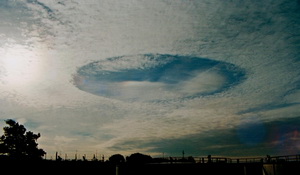 Interestingly, the Didache presents a sequence remarkably similar to that found in the apostolic writings: first, the opening (or breach) in the heavenly expanse (Didache 16:6; Fig. 2), second, a phenomenon that may be perceived visually as the falling of the "stars" (Mark 13:24–25).
To determine the place of these signs within the overall biblical chronology, it is necessary to compare Christ's words with Daniel's prophecy concerning the final seven-year period (Daniel's seventieth week) and to examine the structure of this final seven-year period. Scripture indicates a clear division of this period into two halves of three and a half years each. In Matthew 24:21, the Lord describes precisely the second half of the seven-year period, calling it the "Great Tribulation". Accordingly, the expression «the tribulation of those days» in verse 29 refers to the close of the first half of this seven-year period.
Some interpreters identify the Sign in heaven as a brilliantly shining cross (John Chrysostom, Cyril of Jerusalem, Origen), or as the face of Christ Himself. Others suggest that the image of the Heavenly Jerusalem or an enormous radiant figure of the Son of Man walking upon the clouds will appear in the sky.
Still others have proposed different possibilities: a banner, lightning, an extraordinary star, the resurrection of the dead, the glory of God appearing within a "black hole," an exceptionally brilliant light, an advance host of angels with trumpets and a flaming sword, and other interpretations [Refs. 3, 10–19, 34].
Each of these proposals is interesting in its own way and possesses a certain internal logic. Nevertheless, none of them receives sufficient support directly from the biblical text. For that reason, it is worthwhile to examine the Scriptures themselves once again with great care.
6. Changes in the Sun, Moon, and Stars
«And God said, 'Let there be lights in the expanse of the heavens ... and let them be for signs» ('special signs,' trans. [Ref. 26])." (Genesis 1:14). Thus, from the very beginning of biblical history, the heavenly lights were given by God not only a natural function but also the purpose of serving as signs.
"According to Genesis 1:14–19, the Sun and the Moon, as well as the stars, are to give light to the earth, mark the seasons, and serve as 'signs'" [Ref. 36, p. 118]. This refers to eclipses or other unusual celestial phenomena [Ref. 20, p. 43]. Accordingly, prophecy foretells that extraordinary darkening of the heavenly lights will precede the coming of Yom Adonai.
«The sun shall be turned to darkness, and the moon to blood, before the great and awesome Day of the LORD comes.» (Joel 2:31). This passage refers not merely to a symbol of God's judgment, as proposed by the authors of Ref. 27 [p. 1122], nor simply to an allegory, as maintained by preterists [Ref. 31, p. 178], but to real physical phenomena.
Jesus likewise warns His listeners by listing three significant phenomena: «And there will be signs (there will appear signs) in sun and moon and stars.» (Luke 21:25a). The authors of Ref. 12 describe these as "cosmic signs" (p. 267). The apostle John likewise saw these natural apocalyptic warning phenomena in his vision: «the sun became black as sackcloth, the full moon became like blood.» (Revelation 6:12).
A celestial body—the so-called Star of Bethlehem – served as the sign that guided the wise men from the East to the birthplace of the Messiah, leading them to the town of Bethlehem (Matthew 2:2, 7, 9). Should we therefore conclude that it is not the cross, the Heavenly Jerusalem, or the face of Christ, but rather these three astronomical signs that will announce His coming?
It is tempting to answer "yes," but the more accurate answer is "no." First, the Teacher spoke of one Sign of His return, not three (Matthew 24:30). Second, the three signs mentioned in Luke 21:25, including the darkening of the heavenly bodies, are difficult to reconcile with Jesus' subsequent words:
«For as the lightning (possibly "the radiance of the sun," [Ref. 3, p. 467]) flashes and lights up the sky from one side to the other ("illuminates everything," trans. [Refs. 35, 38]), so will the Son of Man be in his day.» (Luke 17:24; Matthew 24:27).
Here the text speaks not of darkness but, on the contrary, of flashes of light and brilliant radiance. Some scholars point out that the Greek word ἀστραπή (astrapē) used here is etymologically associated with the concept of brilliant light. This observation is supported by Luke 11:36, where the same Greek root is used in the phrase, «as when a lamp with its rays gives you light.» Furthermore, in Matthew 24:30 the verb translated «will appear» (referring to the Sign) is derived from a Greek verb meaning "to shine" [Ref. 21].
Since the mysterious heavenly Sign is to be a manifestation of God's power, it should bear the character of a miracle (Daniel 4:3), becoming an event of worldwide significance – majestic, extraordinary, awe-inspiring, and fear-inducing (Exodus 4:1–9; 7:3; Joel 2:30; Matthew 12:38–40).
Numerous flashes of light in the sky (2 Peter 3:10) will be seen, and «all the tribes of the earth will mourn in despair» (Matthew 24:30; trans. [Ref. 35]; "will cry out in fear and confusion," trans. [Ref. 38]). This naturally raises two questions: "Can we determine what Christ actually meant?" And what biblical evidence allows us to arrive at a sufficiently well-founded conclusion?".
7. The Immediate Context
«Immediately after the tribulation of those days (after the distress of those days), the (1) sun will be darkened, and the (2) moon will not give its light (will not shine), and the (3) stars will fall from heaven, and the (4) powers (bodies) of the heavens will be shaken» (Matthew 24:29; the words in parentheses are explanatory renderings from modern translations).
It is then that the Sign of the Son of Man will appear (Matthew 24:30). We have already seen that the changes in the light of the sun, moon, and stars are not themselves the signals of the Second Coming, as some suppose. Likewise, the shaking of the heavenly powers (bodies) and the falling of the stars cannot be the Sign of verse 30, since they precede it.
Could it be, then, that the consequence of the falling celestial bodies described in verse 29 – "the stars will fall from heaven" – is itself the Sign mentioned in verse 30: «Then rwill appear in heaven the sign of the Son of Man»? Moreover, this Sign will appear at night (2 Peter 3:10; 1 Thessalonians 5:2; Amos 5:18–20).
Let us examine this possibility carefully. What astronomical objects is Jesus referring to in Matthew 24:29? Clearly, He is not speaking of literal stars (Greek, ἀστήρ, – astēr), the enormous hydrogen-helium plasma bodies of immense mass and temperature. At the same time, neither is He referring to symbols or allegories, as preterist interpreters maintain, since the passage describes an actual physical phenomenon.
To understand Matthew 24:29, one should bear in mind that "stars were never an object of scientific interest in the Bible. The term was applied to any luminous heavenly bodies except the sun and the moon" [Ref. 32, p. 616].
Furthermore, "in ancient Hebrew, as in ancient Greek, any bright object in the sky was called a 'star.' This category also included 'falling stars' – meteorites" [Ref. 41, p. 616]. In modern scientific terminology, these are more accurately called meteor bodies, or simply meteors.
We therefore arrive at a well-founded conclusion: the expression «the stars will fall from heaven» in verse 29 essentially refers to "falling stars" [Ref. 41]. In earlier times – and occasionally even today – this term has been used to describe bright, short-lived flashes in the night sky. Such phenomena were believed to result from stars breaking loose from the firmament, which the ancients regarded as solid [Refs. 27, p. 552; 35, p. 1401].
In reality, these flashes are produced when sporadic meteor bodies enter the Earth's atmosphere. These are extremely small solid particles, typically having a mass of less than one milligram, a diameter of less than one millimeter, and atmospheric entry velocities ranging from approximately 11 to 73 km/s.
In the mesosphere and lower thermosphere, at altitudes between approximately 130 km and 60 km, collisions with atmospheric molecules rapidly heat these cosmic particles. Most particles larger than about 10 μm completely vaporize through sublimation – in other words, they effectively "burn up." Micrometeorites with diameters smaller than roughly 4 μm pass through the atmosphere with little or no measurable loss of mass.
The sublimation of meteor bodies is accompanied by luminous emission and ionization of atmospheric gases, allowing an observer at night to see the meteor as a narrow luminous trail (scientifically termed a meteor trail). These trails vary in length, color, and brightness. The ablation of meteors also produces tiny spherical particles ranging from approximately 1 to 100 μm in diameter, commonly known as meteor dust.
These physical processes are highly significant for our study because they help determine whether the heavenly Sign described by Christ could correspond to an actual natural astronomical phenomenon.
Therefore, if in verse 29 the Lord Jesus uses the expression "falling stars" to refer to meteor bodies, then one of the most consistent explanations of the heavenly Sign mentioned in verse 30 may be the radiant. This distinctive feature – or, more precisely, this Sign – would appear in the sky as the result of the massive influx and sublimation of cosmic particles.
These particles would produce a powerful manifestation of God's glory, forming awesome fiery rays that would visually point toward the dark "opening" of the radiant. The resulting luminous phenomenon would resemble lightning, yet would endure far longer than an ordinary electrical discharge, which illuminates the sky only for a brief instant from one horizon to the other.
"Obviously, by the stars falling to the earth one should understand not the sun or the planets, which are larger than our earth, but meteorites" [Ref. 34, p. 376] – or, more precisely, meteor bodies. But why does this heavenly light blaze forth in the evening, illuminate everything throughout the night, and then fade away by morning?
What kind of magnificent cosmic phenomenon could produce a light that, once kindled, would illuminate the entire sky from one horizon to the other, just as the Lord Jesus Christ foretold?
8. The Radiant of the Meteor Stream
As the Earth travels along its orbit at a velocity of approximately 30 km/s, it periodically passes through swarms of solid cosmic particles, most commonly through clouds of dust left by long-disintegrated comets. Similar phenomena have been observed throughout history, although their intensity has been incomparably lower than that anticipated by biblical prophecy.Now, "shooting stars" will appear en masse in the night sky, leaving trails in their wake. This is what is known as a "star shower," and according to the classification of the International Meteor Organization (IMO) – a "meteor storm," when the zenith hourly rate (ZHR) exceeds 1,000, or, in the case of very high activity in the meteor shower, a "superstorm" (ZHR exceeding 10,000 meteors per hour).
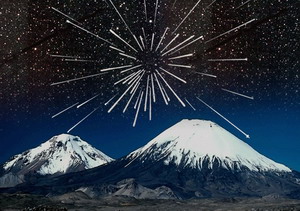
This region of the celestial sphere, from which all visible meteor trails – or their backward extensions – appear to diverge, is called the radiant of a meteor stream, from the Latin radians, meaning "emitting rays."
This phenomenon was first scientifically documented by the American astronomer Denison Olmsted while observing the intense Leonid meteor shower on the night of November 12–13, 1833 (peak ZHR > 100,000). Later, the radiants of the Lyrids, Perseids, Geminids, Draconids, and others were discovered.
At night, the light-emitting object occupies a specific position in the celestial sphere among the constellations—in the one from which the cosmic travelers come, participating in the daily rotation of the stars. In the coming days, under a cloudless night sky, people in many countries will witness an enchanting phenomenon! In the Northern Hemisphere, the powerful radiant itself, with its dark center, will be visible, while in the Southern Hemisphere (up to approximately 25° S) a fainter glow will be visible low above the northern horizon, or individual "earthgrazers."
The brilliance of this unique nocturnal display increases with the Zenithal Hourly Rate (ZHR) – the number of visible meteors per hour. The higher this astronomical Sign rises above the horizon, the more meteor trails become visible within a given period of time. Its radiance will become so intense that, even at night, everything will be visible almost as in daylight, with objects acquiring three-dimensional form through light and shadow.
Therefore, if in verse 29 the Lord Jesus refers to meteor bodies as "falling stars," then the radiant of the meteor stream itself becomes the heavenly Sign described in verse 30. This distinctive Sign will appear – more precisely, it will come into being – as the result of the massive influx of cosmic particles into the Earth's atmosphere. The result will be a luminous phenomenon resembling lightning, yet lasting incomparably longer than the instantaneous flash that illuminates the sky from one horizon to the other.
The extraordinary majesty of this apocalyptic spectacle – the heavens weeping with fiery tears of meteors throughout the night – will overwhelm humanity with the Great Tribulation (Matthew 24:21, 30) and with profound fear (Luke 21:26). Hair will stand on end, and faces will grow pale. As the prophet foretold: «Before them peoples are in anguish; all faces grow pale.» (Joel 2:6).
The Lord further foretells that, at the sight of the calamity drawing near, «people fainting (losing consciousness) with fear and with foreboding (of the disasters) of what is coming on the world. For the powers of the heavens will be shaken» (Luke 21:26; that is, will begin to move).
In this connection, it is worth examining separately the widespread interpretation that identifies the Sign of the Son of Man (Matthew 24:30a) with the Parousia itself (24:30c). A careful reading of the text, however, shows that the Gospel consistently distinguishes these two events in both time and sequence. The Sign in heaven is not Christ Himself, but the majestic cosmic herald of His appearing.
Just as, at the time of the First Coming, the Star of Bethlehem served only as a guide pointing to the birth of the Child and was not the Messiah Himself, so in the last days the radiant of the meteor stream will become the awesome astronomical Sign that precedes the appearance of the King of kings.
At the dawn of the present age, the guiding star served as the Sign of the First Coming of Jesus Christ – a sign of hope. In the last days, the falling stars will announce the Second Coming of the Savior, the King, and the Judge; they will serve as a sign of judgment.
By keeping watch, one may behold the majesty and power of God – the star (the radiant) – in the evening, throughout the night, and at dawn, just like the unexpected return of the master of the house (Mark 13:35). Like a net cast over the earth, this phenomenon will come «... like a trap. For it will come (overtake, fall upon) upon all who dwell on the face of the whole earth» (Luke 21:34, 35).
9. The Broader Context
The expression "from the east ... to the west" in biblical language signifies the universality of a phenomenon; it "encompasses the whole expanse of the earth" [Ref. 7, p. 169]. Consequently, the Lord Jesus is evidently drawing attention not to the atmospheric electrical discharge itself, but to its radiance, since an atmospheric electrical discharge is confined to the region of a thundercloud and cannot illuminate "the whole expanse of the earth."
What is meant is an intense flash, "as the lightning comes" – that is, the distinctive effect it produces: a radiance that illuminates the heavens. This understanding is confirmed by the parallel passage in the Gospel of Luke, where the Greek word ἀστραπή (astrape) denotes bright light or radiance.
«For as the lightning" (astrape) flashes and lights up the sky from one side to the other" ("illuminates everything", trans. [Ref. 35, 38]), so will the Son of Man be in his day» (Luke 17:24). Here the atmospheric electrical discharge serves as "a testimony to the worldwide scope of Christ's return" [Ref. 27, p. 630].
If the foregoing conclusion is correct, then a similar luminous effect ("the radiance of the sun," according to [Ref. 6, p. 389]) could also be produced by the massive influx of meteor bodies emerging from the "opening" in the night sky. Countless flashes of cosmic particles burning up in the atmosphere would illuminate the entire landscape like the dawn spreading across the whole earth.
In that case, the words of the Lord (17:24) may be understood as describing a radiance that, like the sun, illuminates "the whole earth from one end to the other" [Ref. 6]. Unlike an instantaneous atmospheric electrical discharge, however, the radiant continuously illuminates the earth's surface throughout all cloudless night. Der Strahler beleuchtet die Erdoberfläche während einer wolkenlosen Nacht ununterbrochen.
Another important observation follows from the words of Jesus Christ: «but on the day when Lot went out from Sodom, fire and sulfur rained from heaven and destroyed them all (they all perished) – so will it be on the day when the Son of Man is revealed» (Luke 17:29–30).
In Matthew and Mark we read of the same astronomical phenomenon: "the stars will fall from heaven» (Matthew 24:29; Mark 13:25), flashing like lightning (Luke 17:24).
When all these passages are considered together, they portray one and the same extraordinary heavenly phenomenon associated with fire, light, and the falling of objects from heaven. This naturally raises the question: are Luke, Matthew, and Mark describing different aspects of the same event?
If so, then the expression «fire and sulfur rained from heaven» (Luke 17:29) may be understood as describing the very same phenomenon that Matthew calls «the stars will fall from heaven» (Matthew 24:29). From a scientific perspective, this would correspond to the visible effect produced by the ablation of countless small meteor bodies. Even today, their appearance is commonly called a meteor shower or "shooting stars."
In the biblical world, the closest ancient analogue to burning cosmic particles was the bright, rapid combustion of crystals of native sulfur – the so-called "burning stone" [Ref. 36]. Deposits of native sulfur were found in the Jordan Valley [Ref. 7].
Finely pulverized native sulfur possesses pyrophoric properties, that is, the ability to ignite spontaneously. In the absence of external heating, tiny crystals of native sulfur may ignite in air as a result of the exothermic oxidation process. For this reason, following the language of Moses (Genesis 19:24), Jesus Christ refers to the meteor storm as "sulfur."
10. Fiery and Sulfurous Showers
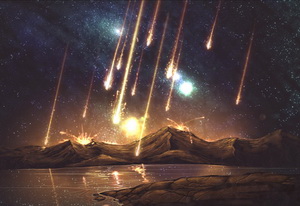
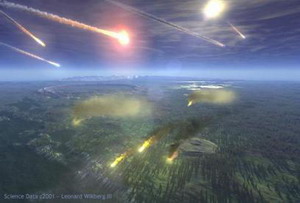 A large meteorite – or, more precisely, a meteoroid while still in flight – appearing as a fiery sphere with a long tail of incandescent gases and solid particles, is called a bolide (from the Greek word meaning "missile" or "throwing spear"; Fig. 4).
Its descent ends with impact upon the Earth's surface and the formation of an impact crater. In most cases, however, the meteoroid disintegrates while still in the atmosphere under the combined effects of dynamic pressure (approximately 0.1–1 MPa) and thermal stress produced by aerodynamic heating (1,800°C – 3,000°C) during atmospheric deceleration.
The dazzling flash is followed by a loud explosive report and the fall of numerous small fragments. Planetary scientists refer to this final stage as a meteorite shower; in everyday language it is often described as a "star shower," a "stone shower," or a "fiery shower."
Within the framework of the proposed hypothesis, this provides a possible way of understanding the description of the "fiery hail" in John's vision (Revelation 8:7). The point is not to identify these phenomena as identical, but rather to note the similarity in their visual appearance from the perspective of an observer on Earth. In particular, the seer witnessed the flight and atmospheric breakup of a bolide, describing it as «a great star fell from heaven, blazing like a torch» (v. 10).
This imagery corresponds remarkably well to the flight and fragmentation of a large meteoroid. The comparison is natural, since both a cosmic body before its atmospheric breakup and a "torch" burning in the wind produce a bright flickering light, tongues of flame, sparks, and smoke. A blazing cosmic body is capable of casting shadows from objects on the ground even during daylight, much as a brilliant lamp does at night.
Because of the intense infrared thermal radiation emitted during the flight of an exceptionally bright meteoroid, an observer on the ground experiences an intense sensation of heat, much like that produced by a blazing "torch". This physical characteristic makes the comparison especially vivid. Indeed, a bolide closely resembles a torch: it emits a brilliant flickering light, leaves behind a trail of smoke and sparks, and even produces perceptible thermal radiation.
11. The Day of the LORD
I venture to offer a scientific and physical explanation of this unique and remarkably concise prophecy (vv. 10–12) in an attempt to address several difficult questions that naturally arise when reading it:
- How can the Day of the Lord come at night?
- Why is it compared to a thief?
- How should we understand Peter's words about the burning heavenly bodies and the heavens passing away with a roar?
It is noteworthy that during the Passover Seder, observant Jews recite an acrostic composed by Rabbi Yannai, concluding with words concerning the coming of the Messiah: "Make the darkness of night shine with the radiant light of Your day" [Ref. 23]. Similarly, 2 Esdras contains a remarkable eschatological prophecy (5:1, 4): "Concerning the signs... the sun shall suddenly shine at night" [Ref. 24].
Second, Peter's comparison of the Day of the Lord to a thief may at first seem inappropriate or even degrading. Yet the image of a "thief" appears not only here but also in John's writings (Revelation 3:3; 16:15) and in Paul's (1 Thessalonians 5:2, 4). Therefore, it can hardly be regarded as either inappropriate or accidental. Moreover, the Old Testament prophet likewise compares the Day of the LORD to a robber (Joel 1:15, trans. [Ref. 35]).
The traditional explanation is that the apostles employed the image of a "thief" solely to emphasize the suddenness of Christ's coming (Refs. 27, pp. 45, 263; Ref. 29, p. 571). Yet had Peter wished only to stress its unexpectedness, other linguistic expressions were available to him.
This invites us to consider whether the image of the thief in the night also carries an additional nuance of meaning. If this is so, what additional idea was Peter conveying through the image of the thief? Certainly not the destruction associated with the heavenly bodies (2 Peter 3:10), since, according to the proposed chronology, humanity will have learned of its approach at least three and a half years beforehand (Daniel 9:27; Joel 2:31; Revelation 6:2).
The unusual comparison of the Day of the LORD to a burglar who breaks into a house may be understood as follows. In antiquity, theft was often committed "under the cover of darkness" (Ref. 27, p. 180). The burglar secretly entered a house by digging an opening through a wall made of mud bricks (Ref. 25, p. 180; Ref. 3, p. 153).
Accordingly, when Jesus exhorts His followers to remain watchful until His return, He says: «But know this, that if the master of the house had known in what part of the night the thief was coming, he would have stayed awake and would not have let his house be broken into» (Matthew 24:43; literally, "dug through", according to another translation).The Greek verb διορύσσω (dioryssō) literally means "to dig through."
Within the framework of the proposed reconstruction, the radiant may be understood as an image of precisely such a breach in the heavens – a "hole," an "opening," or a rupture. Isaiah cries out to Yahweh Elohim:
"Oh that you would rend the heavens and come down" (Isaiah 64:1; "having torn open the heavens, descend to the earth," trans. [Ref. 26]). The psalmist describes the torn firmament as an old (worn-out, threadbare, literally, full of holes) garment that Adonai will replace (Psalm 102:26).
- be "dissolved" (2 Peter 3:10, 12; "(destroyed by fire" ), as happens when bolides fragment in flight;
- or "melt" (v. 12), completely vaporizing, as occurs with small meteoroids.
Figuratively speaking, the world will become like a fiery crucible in which humanity is purified from its sinful works before the dawn of the new Messianic age.
12. Biblical Parallelism
Let us begin with the Old Testament, namely the Book of Psalms, where Psalm 18 recounts a theophany, naturally expressed in mythopoetic language through the use of anthropomorphisms.
Out of the brightness before him hailstones and coals of fire (fiery sparks) broke through his clouds (His dazzling radiance burst through the clouds). The LORD also thundered in the heavens, and the Most High uttered his voice, hailstones and coals of fire.
And he sent out his arrows and scattered them; he flashed forth lightnings (cast, scattered) and routed them» (Psalm 18:7–14; the words in parentheses reflect clarifications from modern translations).
Despite the figurative character of this narrative, it contains a number of striking features that closely correspond to New Testament eschatological passages. This awe-inspiring description, even in its details, echoes Christ's prophecies concerning His return (Matthew 24:27–30; Mark 13:24–26; Luke 17:24–30). At the same time, Psalm 18:7–14 also resembles several of the visions granted to John. For example:
«When he opened the sixth seal, I looked, and behold, there was a great (mighty) earthquake... and the stars of the sky fell to the earth... The sky vanished (disappeared) like a scroll that is being rolled up, and every mountain and island was removed (shifted) from its place», «hail and fire, mixed with blood, were thrown upon the earth» (Revelation 6:12–17; 8:5–12; 16:18–21; the words in parentheses reflect clarifications from modern translations).
The cosmic phenomena witnessed by John are described by him as stars (6:13), fire, a mountain, and a star (8:7–10; 9:1); Isaiah refers to them as the host of heaven (Isaiah 34:4). The Evangelists Matthew and Mark describe meteors as stars (Matthew 24:29; Mark 13:25), Luke speaks of fire and sulfur rained (Luke 17:29–30), while the Apostle Peter refers to them as heavenly bodies that have become incandescent (2 Peter 3:10, 12).
The image of the incandescent heavenly bodies may reasonably be correlated with the phenomenon of the massive influx of meteor bodies. David perceives them as "glowing coals" (Psalm 18:8, 12, 13; trans. [Refs. 37, 38]). The sublimation of meteors, together with the formation of thunderclouds, will produce powerful electrical discharges in the Earth's atmosphere—the "lightnings" mentioned in verse 14.
If this interpretation is correct, then the mysterious flashes of meteors may well be what the Old Testament prophets describe as the arrows and spears of the LORD of hosts (Habakkuk 3:11; Zechariah 9:14; Isaiah 50:11). If the "fiery sparks" are understood as meteor trails, then a further question naturally arises: what celestial phenomenon lies behind these images in Psalm18?
13. What Do the Mouth of the Heavenly Warrior Represent?
David uses the "mouth" of Yahweh Elohim (Psalm 18:8) as an image of the opening in the heavens—the mysterious radiant of the meteor stream that drives away the clouds (v. 12).
This is hardly surprising, given the cosmic scale and heavenly nature of the miracle, since "images of great size are associated with God in the Bible" and "are likewise employed to portray God's power and judgment" (Ref. 27, p. 106).
It is He who controls the atmospheric phenomena (Jeremiah 10:13), who brings out from His storehouse the weapons of His wrath (Jeremiah 50:25) «for the day of battle and war» (Job 38:22–23). According to the commentators, these weapons "are set in motion by the wind awakened by His breath" (Ref. 28, p. 635).
David sees that, at the breath of the Heavenly Warrior, «Smoke went up from his nostrils, and devouring fire from his mouth» (Psalm 18:8). Hebrew literature abounds in synecdoches—figures of speech in which a part represents the whole (Ref. 27, p. 252). The psalmist thus perceives the gigantic "mouth" of El Shaddai in His heavenly dwelling (Psalms 2:4; 13:2).
The prophet Isaiah likewise foretells that before the establishment of the Messiah's kingdom, He «shall strike the earth with the rod of his mouth, and with the breath of his lips he shall kill the wicked» (Isaiah 11:4b). In one of his visions, the Apostle John employs precisely the same imagery: «from his mouth came a sharp two-edged sword» (Revelation 1:16b; 19:15).
It is noteworthy that the Hebrew word פֶּה (peh, "mouth") also carries the meaning of "opening" (Genesis 29:2; Joshua 10:18, 22; Daniel 6:17). In its literal sense, peh denotes an entrance or an opening in something—for example, a well, a cave, or a sack (Ref. 27, p. 1006).
The Didache – the earliest and most authoritative catechetical document of the post-apostolic period—describes the Sign of the Second Coming as the sign of an opening in heaven: «Then shall appear the signs of the truth: first, the sign of an opening in heaven... Then the world shall see the Lord coming upon the clouds of heaven.» (Didache 16:6–8).
The prophet Ezekiel describes the breach in the heights above the clouds as a sheath from which Yahweh Sabaoth will draw His sword. At the sight of it, the nations will lose their senses (Jeremiah 25:16). «And all flesh shall know that I am the LORD. I have drawn my sword from its sheath, and it shall not be sheathed again» (Ezekiel 21:5; "not returned there" Ref. 35).
Thus, independent of one another, different biblical authors employ the imagery of an "opening," "mouth," "sheath," "breach," and "the heavens being torn open," associating all these images with the future judgment of God.
This naturally gives rise to two questions. Could all these images describe one and the same celestial phenomenon, expressed through different literary devices? And, does the biblical text itself provide sufficient evidence to identify, at least approximately, the region of the sky where it will appear?
If these considerations are correct, then the biblical text may preserve not only the symbolic image of this phenomenon but also a number of individual features that make it possible to estimate the probable location of the radiant of the meteor stream.
According to the proposed conceptual reconstruction and the corresponding calculations, the author suggests that the mouth of these prophetic sheaths – the torn heavens, their "opening" – may be discerned by the inhabitants of the earth within the circumpolar constellation Cepheus in the Northern Hemisphere.
It is important to emphasize that, in this case, we are not talking about one of the well-known annual faint Cepheid meteor showers. We are talking about a powerful, rare phenomenon: in the final days of history, a spectacular meteor and asteroid shower (ZHR > 150,000, which is more than 40 meteor flashes per second) will appear from this region of the celestial sphere.
Moreover, in the tradition of ancient uranography, the circumpolar constellation Cepheus represents the figure of a King, making it an ideal prophetic landmark for the appearance of the Sign of the King of kings in heaven and for the judgment of all nations (Matthew 24:29–30; Revelation 1:7; 19:11–21).
The proposed localization of the radiant within the polar region of the Northern Hemisphere is not based upon any single argument. Rather, it results from the convergence of several independent lines of evidence—biblical, astronomical, historical, and symbolic. The proposed interpretation rests upon four principal considerations.
First, according to numerous Old Testament prophecies, the eschatological judgment and «disaster from the north, and great destruction» will come upon Israel from the north (Jeremiah 4:6, 1:14; Ezekiel 21:4; 38:6, 15; 39:2; Isaiah 14:31).
Second, on both ancient and modern astronomical charts, the outline of Cepheus forms a clearly enclosed figure whose principal stars create an irregular pentagon resembling a cone or a funnel – the visual embodiment of an opening or "mouth" (peh).
Third, this outline is formed by seven principal stars visible to the naked eye (although the constellation contains 234 catalogued stars, only seven are brighter than fourth magnitude). This establishes a direct prophetic parallel with the mystery of the "seven stars" in Christ's right hand (Revelation 1:20).
Fourth, the constellation possesses remarkable symbolic significance. In traditional uranography it represents a King holding an upraised scepter directed toward the earth, as though indicating the beginning of the judgment of the King of kings.
If these considerations are correct, they enable us to visualize how this Sign might appear to an observer on earth. At the latitude of Jerusalem, the radiant of the Cepheus meteor stream could be seen in the evening low above the northern horizon. Throughout the night, the radiant – the "opening" from which the rays appear to emerge – would gradually rise above the horizon while moving eastward.
From this very region of the celestial sphere will come what the biblical writers describe as the instruments of God's judgment: first a stream of meteor bodies, and later meteoroids and asteroids descending upon the earth with roaring, rumbling, and whistling sounds. Isaiah describes this astronomical Sign as a military signal – rendered as "flag" in some translations – raised by the LORD of hosts to assemble His army.
Whenever we read about the mouth of Adonai, or that He raises a banner, gives a Sign, whistles, goes forth, sees, or hears, we are encountering archaic anthropomorphisms – of which the Bible contains many (Ref. 20, pp. 121, 309). More precisely, we are dealing with personification – the attribution of human characteristics to God, to natural phenomena, or to otherwise unknown realities.
14. Unusual Weapons
Particular attention should be given to the repeated biblical descriptions of God's judgment through imagery of fire, smoke, burning breath, and the use of unusual weapons. Can these images be understood in the light of modern natural science? Let us examine this possibility.
Isaiah writes succinctly: «They come from a distant land, from the end of the heavens (the horizon), the LORD and the weapons of his indignation, to destroy the whole land.» (Isaiah 13:5; Jeremiah 6:22; Deuteronomy 28:49).
By the mysterious "weapons of His indignation" ("the army of retribution," trans. [Ref. 26]), the prophet apparently means the heavenly host—that is, the "stars" (meteor bodies). Falling from heaven (Isaiah 34:4; Fig. 5). Just as the stars once fought against Sisera (Judges 5:20), so they will take part in the war against the earth (Revelation 8:10–12; 9:1–3; 12:4).
 Elsewhere Isaiah describes the coming of the LORD (Isaiah 30:27). Once again, the image of His mouth appears (an anthropomorphism), as the source of His burning indignation, with His tongue like a devouring fire. «...his anger in thick rising smoke.» (Isaiah 30:27b; trans. [Ref. 38]).
The Hebrew word for "anger," אַף ('aph), also means "nostril" or "nose." Modern translations of Psalm 18:8 render the passage as follows: «Smoke went up from his nostrils» (ESV); "Smoke poured from His nostrils; from His mouth came consuming fire, and fiery sparks flew forth" (trans. [Ref. 26]).
The Hebrews understood that God cannot be represented in any bodily form, yet they readily employed personification – that is, describing Him by means of familiar, tangible images (Ref. 28, p. 596).
If all these passages are considered in the light of the proposed reconstruction, then Psalm 18:8 and Isaiah 30:27 appear to describe something more than mere allegory. In modern scientific terms, they may well refer to bolides (Revelation 8:10)—fireballs trailing long tails of smoke (Figs. 4–5), issuing «from his nostrils» (Psalm 18:8a), «in the day of His fierce (burning) anger» (Isaiah 13:13).
The comparison of wrath with burning fire is common in Hebrew and related Semitic languages (Ref. 1, p. 512). "The root of the Hebrew word translated 'anger' literally means 'hot breath.' God's wrath burns like fire, consuming everything in its path" (Ref. 33, p. 368).
When Nahum describes his vision of the theophany, he appears to refer both to Yahweh's "burning breath" and to the blood-red heavens veiled by the "dust" raised from His "feet" (Nahum 1:2–6). Likewise, John employs the image of the wrath of Him who sits on the throne and of the Lamb in one of his eschatological visions (Revelation 6:16–17).
If this interpretation is correct, it should account not only for the imagery of fire, but also for the accompanying biblical descriptions. One of these is the repeated mention of the "blood-red" or "fiery" sky.
It is conceivable that this is precisely what will occur. As enormous quantities of mineral dust fill the atmosphere during the Day of the LORD, its optical properties will undergo a profound transformation. The color of the sky, normally determined primarily by the molecular scattering of sunlight, will change from blue to blood-red because aerosol scattering by micron-sized suspended particles will become dominant.
In atmospheric physics, this phenomenon is well explained by the theory of light scattering by aerosol particles (the so-called Mie scattering). Unlike ordinary Rayleigh scattering, which gives the daytime sky its blue color, the enrichment of the mesosphere and stratosphere with fine silicate and iron-rich meteoritic dust would suppress the short-wavelength (blue) portion of the solar spectrum. As a result, predominantly the longer red wavelengths would reach the Earth's surface.
Throughout Earth's history, similar localized optical effects producing a "blood-red sky" have been observed after catastrophic volcanic eruptions (for example, Krakatoa), when volcanic ash was injected into the upper atmosphere. During the eschatological Day of the LORD, however, this phenomenon would occur on a planetary scale as a consequence of Earth's encounter with a meteor-asteroid stream arriving from deep space.
This physical transformation of the sky from blue to blood-red may correspond to one of the mysterious astronomical Signs described by the prophet Joel ("blood" in Joel 2:30). The Apostle Peter describes the heavens of the last days of the present world as «the heavens will be set on fire and dissolved» (2 Peter 3:12), while Paul speaks of «in flaming fire» (2 Thessalonians 1:8).
Therefore, within the framework of the proposed reconstruction of future events, these biblical images may be correlated with natural phenomena that modern science describes in its own terminology. In this interpretation:
- the image of God's mouth or nostrils breathing forth fire may correspond, in modern astronomy, to the geometric center of the radiant of a meteor storm;
- the image of burning coals, arrows, and spears may correspond to the processes of ablation and ionization occurring as meteors and bolides pass through the dense layers of the atmosphere;
- the image of a blood-red sky or a sky engulfed in flames may correspond to aerosol scattering of sunlight by fine meteoritic dust particles.
15. The Hiding Place, Arrows, and the Quiver
«The sun and moon stood still in their place at the light (radiance) of your arrows as they sped, at the flash (radiance) of your glittering spear (spears)» (Habakkuk 3:11, "they lost their brightness and ceased to shine, beholding the brilliant flashes," trans. [Ref. 26]).
While reading these verses (3:3–19), together with other passages concerning the Day of the LORD, both in the Old and the New Testaments, one gains the strong impression that they all describe the same miraculous event – the Second Coming of the Messiah. Despite differences in vocabulary, all these texts agree in their central message, do not contradict one another in their details, and mutually complement one another.
For example, Habakkuk provides an important addition concerning the extraordinary arrows and spears of the Almighty mentioned earlier: His arrows shine, and His spears radiate light (Habakkuk 3:11). The prophet does not perceive them as lightning, unlike Zechariah (Zechariah 9:14) and Christ (Luke 17:24), where the Greek word astrapē denotes radiance rather than an electrical discharge in the atmosphere during a thunderstorm.
Atmospheric lightning channels typically have a jagged, branching form with numerous zigzagging offshoots. By contrast, fiery arrows, spears, and darts resemble almost perfectly straight lines. This description corresponds remarkably well to the perfectly linear trails left by meteor bodies igniting in the atmosphere – small ones (arrows and darts; Fig. 3) as well as large ones (the spears of bolides; Figs. 4 and 5).
The prophet describes these bright, perfectly straight luminous tracks as rays, whereas the dark opening of the radiant is portrayed as the hiding place of God's power (glory): «Rays (literally, "horns") flashed from his hand; and there he veiled (hid) his power» (Habakkuk 3:4b).
Particular attention should be paid to this unique comparison. The ancient Semitic image of horns (Hebrew קַרְנַיִם – qarnaim) conveys with remarkable precision the dynamic geometry of the radiant, from whose single center sharp, narrow meteor trails visually spread outward and rapidly lengthen in every direction.
The light of this extraordinary heavenly Sign – the "night sun" – is described by the prophet as the majesty of God. «His brightness was like the light» ("like the light of dawn," trans. [Ref. 38]) (v. 4). This is the glory of Yahweh Elohim, which covers the heavens and fills the earth (Habakkuk 3:3b).
This extraordinary heavenly Sign will encompass the entire firmament and, like the dawn, will shake the wicked out of their hiding places, as it is written: «...that it might take hold of the skirts of the earth, and the wicked be shaken out of it» (Job 38:13). Jeremiah compares the dark opening of the radiant to the dark circular entrance of a tomb: «Their quiver is like an open tomb» (Jeremiah 5:16).
He records this remarkable visual phenomenon and identifies this astronomical Sign in the heavens with an open cylindrical case for deadly arrows: «Their quiver is like an open tomb» (Jeremiah 5:16). The ancient round quiver, from whose opening arrows fly out one after another, becomes an extraordinarily apt image of the eschatological radiant, continuously giving rise to fiery arrow-like meteor trails.
16. The Strange Radiance
This phenomenon may be described as a hidden luminary of the night sky, "the hiding place of His power," or even as His eye (vv. 4, 6), since the ancients believed that the eye itself emitted light. If this hypothesis is correct, a natural question arises: why does Habakkuk say, «God came from Teman, and the Holy One from Mount Paran»? After all, these places lie south of Israel, whereas the opening that emits the rays first appears in the northern part of the sky.
Most likely, Habakkuk is describing not the faint evening radiant low above the northern horizon, but the culmination of "the hiding place of His power" early in the morning, after the Sign has moved into the southern sky. At that moment, because of the brilliance of El Shaddai's flashing spears and His flying arrows, neither the setting Moon nor the rising Sun is visible. Thus, the apparent geographical contradiction between the northern appearance of the Sign and its southern culmination is resolved by the laws of astronomy.
What we see, therefore, is not a contradiction between prophetic accounts but a consistent chronological description of a single process. Having begun under the cover of night in the north (within the constellation Cepheus), the dynamic eschatological meteor storm gradually shifts southward by morning as a consequence of the Earth's axial rotation – a sequence that different biblical prophets recorded in their respective visions with remarkable consistency.
Let us consider another intriguing observation made by Habakkuk, who declares: «The sun and moon stood still in their place» (Habakkuk 3:11). In the Masoretic Text this reads, "they stood still in their habitation," which many modern translations understand as describing the loss of their brightness in the presence of an overwhelming radiance. For example: "The moon and the sun lost their brightness and ceased to shine" (trans. [Ref. 26]).
This unusual – and for the modern reader almost unbelievable – prophecy may be explained by the combined effect of two well-known natural optical phenomena. Atmospheric refraction near the horizon briefly creates the impression that the Sun and the Moon have paused or "stood still" in the sky.
At the same time, the intense illumination of the atmosphere produced by the continuous flashes of countless meteors could reduce their apparent contrast so dramatically that the Sun and the Moon might visually seem to have "lost their brightness" or even to have "ceased to shine," as some modern translations render the passage.
Let us return to the prophet's words: «rays (literally, 'horns') flashed from his hand; and there he veiled (hid) his power» (Habakkuk 3:4). Unlike the rays of the sun, meteor trails continually appear and disappear; yet when the meteor stream reaches very high intensity, its overall spatial pattern remains nearly unchanged. To an observer, it resembles a gigantic wheel in the heavens, from whose center luminous spokes seem to "rotate" ceaselessly in every direction.
It is precisely this extraordinary geometry that may have given rise to the ancient symbol of the heavenly wheel, well known among the peoples of the Ancient Near East and employed by biblical authors as a symbol of God's presence and His power.
For this reason, an astronomical Sign with an exceptionally high ZHR (Zenithal Hourly Rate) could naturally have reminded the prophet Habakkuk of the rapidly revolving spokes of an iron war chariot [Ref. 28, p. 254]. During the New Kingdom of Egypt, such chariots were equipped with metal spokes, while their warriors carried bows with arrows, darts, and spears.
Perhaps for this very reason – and also because of its immense size and its movement across the heavens – Isaiah employs the image of the heavenly Sign as Yahweh's chariot, since both the chariot and its wheel were widespread astral symbols in the ancient world.
«For behold, the LORD will come in fire, and his chariots (in the Masoretic Text, “chariot") like the whirlwind, to render his anger in fury, and his rebuke with flames of fire.» (Isaiah 66:15; Malachi 4:1). "The prophets Isaiah and Malachi identify the fire with the Second Coming of Christ" [Ref. 29, p. 73].
17. God's Lamp and His Face
The Bible also employs other images and designations for this mysterious heavenly Sign that overwhelms the imagination—the immense, awe-inspiring, visible manifestation of the Creator's presence. Thus, Zephaniah describes His visitation of Jerusalem as «A day of wrath... a day of darkness and gloom» (Zephaniah 1:15).«At that time I will search Jerusalem with lamps, and I will punish (the complacent) the men who are complacent,
those who say in their hearts, "The Lord will not do good, nor will he do ill."» (Zephaniah 1:12).
Here the prophet uses the image of people who have "settled on their lees" (Ivan Ohienko's translation), that is, people who have become complacent and indifferent to everything around them. Therefore, the Almighty acts in a manner analogous to an ancient Jewish custom. On the night before the spring Passover feast, the head of the household, carrying a lamp, searched the entire house to make sure that every trace of leaven had been removed (Exodus 12:19).
Yet the immense scale of the event described (Zephaniah 1:2-4, 12, 16-18) suggests that the prophet has in mind an extraordinary lamp – the radiant itself – belonging to Eloah. Throughout the darkness of the night, it illuminates the whole city (v. 12).
John sees those who have hidden themselves in caves and among the rocks of the mountains, crying out to the rocks and the mountains: «Fall (collapse) on us and hide us from the face (Hebrew "pānîm") of him who is seated on the throne, and from the wrath of the Lamb.» (Revelation 6:15–16).
In another vision, while being in the Spirit, the apostle himself beholds the Most High. He compares the One who holds the seven stars to a brilliantly shining luminary: «his face was like the sun shining in full strength.» (Revelation 1:16; "His whole appearance was like the blazing sun at its zenith," trans. [Ref. 35]).
Thus, in this context, the prophetic expression "the face of God" may refer to that same mysterious heavenly phenomenon – the Sign in the sky (Matthew 24:30) – whose radiance will dazzle the earth like the blazing noonday sun at its zenith (Revelation 1:16).
Light proceeds from this divine manifestation, just as in David's psalm: «His dazzling brightness tore through the clouds» (Psalm 18:13, trans. [Ref. 26]). According to the ancient Near Eastern tradition, such a manifestation was regarded as dangerous for human beings [Ref. 27, p. 613].
Therefore, in the parallel verses we read: «Enter into the rock and hide in the dust from before the terror of the LORD, and from the splendor (because of the radiance) of his majesty.» (Isaiah 2:10; cf. vv. 19, 21). The expressions "the terror of the LORD," "the splendor," and "the radiance of His majesty" may likewise refer to the same astonishing heavenly phenomenon – the awesome radiant of a meteor shower, evidently brought about by God's providence.
18. The Great Winepress
Another designation for God's extraordinary "hiding place of power," employed by the Apostle John, is the image of «the great winepress of the wrath of God» (Revelation 14:19), or «the winepress of the fury of the wrath of God the Almighty» (Revelation 19:15).
In ancient times, a winepress was a pit (Isaiah 5:2; Matthew 21:33) hewn out of rock or dug into the ground and lined with stones and clay. Grapes were trodden underfoot in this pit to extract their juice [Refs. 27, 29]. "The red juice flowed through openings into collecting vessels" [Ref. 36]. "In the surreal vision, blood flows from the winepress instead of wine (Revelation 14:20)" [Ref. 27, p. 1213].
Jeremiah compares the loud cries of the vinedressers treading the grapes to the mighty voice from heaven on the Day of Judgment against the nations: «The LORD will roar from on high... he will roar mightily (against all the inhabitants of the earth).» (Jeremiah 25:30; in modern physical terminology, an acoustic shock wave will descend from above.)
There will be "thunder" (trans. [Ref. 35]) and "a roaring sound" [Ref. 37], or more precisely, "an uproar" (Masoretic Text), sweeping across the entire planet (v. 31). Instantly, a great whirlwind – a hyper-hurricane – will arise, as it is written: «disaster is going forth from nation to nation, and a great tempest is stirring from the farthest parts of the earth.» (Jeremiah 25:32). An unimaginable calamity will race from one nation to another.
The image of the ancient winepress also appears in the Old Testament in connection with the terrifying coming of the Heavenly Warrior on «the day of vengeance» (Isaiah 63:1–6).
«Why is your apparel red, and your garments like his who treads in the winepress?... I trod them (the nations) in my anger (wrath, fury) and trampled them in my wrath; their lifeblood (blood) spattered on my garments, and stained all my apparel.» (Isaiah 63:2–3 parenthetical clarifications from other translations).
This shocking image of nations crushed like grapes beneath the feet of the one treading the winepress should not be understood literally (the Hebrew word neṣaḥ can denote both "blood" and "grape juice" [Ref. 38, p. 1088]).
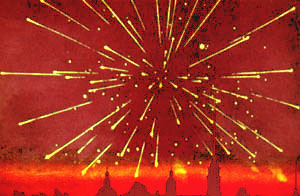
The meteor trails bursting forth from this center resemble the radial splashes of grape juice, while the crimson sky, reddened by atmospheric dust, is likened by the prophets to the purple garments of the Heavenly Warrior, stained with blood.
Thus, the present study of Scripture permits the conclusion that the spiritual sign of the return of the Lord Jesus Christ is the completion of the proclamation of the Gospel of the coming Messianic Kingdom. The physical Sign, according to the interpretation proposed in this study, will be a grandiose, powerful nocturnal radiant, unique in its nature, resembling the brilliant sun at its zenith.
In those days, the stars will mourn; the heavens will proclaim the righteousness of God; everyone will behold His glory... and all who worship idols will be put to shame (Psalm 97:3–6). For this reason, one must not place all hope in man, for everything created by human hands will ultimately crumble.
The path to truth that relies solely on empirical scientific inquiry is often long, since it proceeds through countless trials and errors. By contrast, the one who listens attentively to the Lord receives truth by revelation, making that path much shorter.
REFERENCES
[1] The IVP Bible Background Commentary. Part 2: New Testament. – St. Petersburg: Mirt, 2005. – 733 p.
[2] Lloyd-Jones, M. The Church and the Last Times. – Kharkiv: D. F. Tkachenko, 2001. – 208 p.
[3] Kuznetsova, V. M. The Gospel of Matthew. Commentary. – Moscow: A. Men OPU, 2002. – 568 p.
[4] Pash, R. The Second Coming of Jesus Christ. – Gummersbach: World Messenger Mission, 1995. – 287 p.
[5] Wood, Leon J. The Bible and Future Events: An Introductory Survey of Last-Day Events. – St. Petersburg: Bible for Everyone, 2006. – 213 p.
[6] Kuznetsova, V. M. The Gospel of Luke. Commentary. – Moscow: A. Men OPU, 2004. – 556 p.
[7] Rienecker, F., Maier, G. The Brockhaus Bible Encyclopedia. – Kremenchuk: Christian Dawn, 1999. – 1088 p.
[8] Youngren, P. The Sign. – Kyiv: Varukh, 1998. – 192 p.
[9] Stern, D. Jewish New Testament Commentary. – Moscow: Siloam, 2004. – 1,156 p.
[10] MacArthur, John F., Jr. The MacArthur New Testament Commentary: Matthew 24–28. – Minsk: Slavic Evangelical Society, 2008. – 410 p.
[11] MacDonald, W. Believer's Bible Commentary. New Testament. – Bielefeld: CLV, 2000. – 1,467 p.
[12] Commentary on the Four Gospels and the Book of Acts. – Biblical Department. – Kyiv: Demos, 1994.
[13] Lopukhin, A. P. (Ed.). The Explanatory Bible. Vol. 3: New Testament. 2nd ed. – Stockholm: Institute for Bible Translation, 1987. – 612 p.
[14] Barchuk, Ivan. Exposition of the Four Gospels. Vol. 2. – Kyiv: The Way of Truth, 1993. – 618 p.
[15] Kanatush, V. Ya. The Mysteries of the Apocalypse. – Minsk: Revival Church, 1993. – 168 p.
[16] Muzychko, I. V. The Light of Revelation. – Toronto, 1995. – 224 p.
[17] Van Kampen, Robert. The Rapture Question Answered Simply. – Moscow: Triada, 2000. – 232 p.
[18] Miles, George A. Prophecy Charts. – Kyiv–Odesa: VSM, 1995. – 50 p.
[19] LaHaye, T., Jenkins, J. It Could Happen Today. – St. Petersburg: Bible for Everyone, 2005. – 248 p.
[20] Shchedrovitsky, D. V. Introduction to the Old Testament. – Moscow: Terevinf, 2001.
[21] Rogers, Cleon L., Jr., Rogers, Cleon L., III. The New Linguistic and Exegetical Key to the Greek New Testament. – Moscow: Bible for Everyone, 2001. – 1008 p.
[22] Karev, A. V., Mitskevich, A. I., Popov, V. A. Exegetics. – St. Petersburg: Bible for Everyone, 1997. – 208 p.
[23] Clifford, P. The Last Times. – St. Petersburg: Mirt, 2000. – 219 p.
[24] The Bible. – Moscow: Russian Bible Society, 1998. – 1,376 p.
[25] Bible Encyclopedia. – Moscow: Russian Bible Society, 1996. – 352 p.
[26] The Bible. Contemporary Translation of the Biblical Texts. – Moscow: World Bible Translation Center, 2002. – 1,150 p.
[27] Dictionary of Biblical Imagery. – St. Petersburg: Bible for Everyone, 2016. – 1,423 p.
[28] The IVP Bible Background Commentary. Part 1: Old Testament. – St. Petersburg: Mirt, 2003. – 984 p.
[29] Commentary on the New Testament Epistles and the Book of Revelation. Chief Editor: Harchlaa. – Seligenstadt: Christian Publishing House, 1990. – 598 p.
[30] Commentary on the Old Testament Books: From Isaiah through Malachi. – Ashford: Slavic Missionary Publishing House, 1996. – 602 p.
[31] MacArthur, John F. The Second Coming: Signs of Christ's Return and the End of the Age. – West Sacramento: Grace Publishing International, 2007. – 358 p.
[32] New Bible Dictionary. Part 2: Biblical Realities. – St. Petersburg: Mirt, 2001. – 1,014 p.
[33] Stedman, Ray. Adventuring Through the Bible. – USA: Worldwide Printing, 2005. – 704 p.
[34] Dudnik, A. V. Commentary on the Book of Revelation. – Khartsyzk: Svitlo, 2012. – 975 p.
[35] The Bible. The Books of the Holy Scriptures of the Old and New Testaments. Canonical. Contemporary Russian Translation. – Moscow: Russian Bible Society, 2011. – 1,408 p.
[36] The Great Bible Dictionary. – St. Petersburg: Bible for Everyone, 2005. – 1,503 p.
[37] The Bible. A New Russian Translation. – Carlisle, United Kingdom: Biblica Europe, 2011. – 1,185 p.
[38] The Bible. The Books of the Holy Scriptures of the Old and New Testaments in Contemporary Russian Translation. – Moscow: BBI Publishing House, 2015. – 1,856 p.
[39] Derek, T. Isaiah. – Minsk: Ya. Kolas Polygraphic Plant, 2013. – 400 p.
[40] Prokopenko, O. V. Heralds of the Kingdom: Theology of the Old Testament Prophets. – Kharkiv: Globus, 2016. – 414 p.
[41] Sarfati, J. D. The Genesis Account. – Kyiv: Knyhonosha, 2018. – 864 p.