«And this gospel of the kingdom will be proclaimed
throughout the whole world as a testimony to all
nations, and then the end will come.»
(Matthew 24:14, ESV)
«The sun shall be turned to darkness, and the moon
to blood, before the great and awesome day of the
LORD comes.» (Joel 2:31, ESV)
The term "the end of the world" in this article does not mean the destruction of planet Earth, but rather the end of the existence of modern technological civilization and a radical transformation of the world order. To the question, “Will there be an end of the world?” the most probable answer is "YES." For the continued existence of this evil, adulterous, and faithless generation has lost its purpose, having distorted its calling and departed from its path.
In many contemporary worldviews, the place of the Creator is occupied by man himself, by humanity, or by an impersonal cosmic force elevated to the rank of a deity, while purposeless evolution is regarded as the driving force of nature. Society is urged to be tolerant of everything that happens, since everything has allegedly become relative: evil, good, truth, and moral values, and the world itself is supposedly neither good nor bad.
On the contrary, the world is beautiful. But can anything beautiful come into existence without a Supreme Intelligence? An absolute moral law exists, and neither an individual, nor a people, nor a nation can violate it with impunity. Unfortunately, our lawlessness has finally separated the creation from the Creator—everyone lives according to his own will. All who have lost the ability to distinguish good from evil follow their own "right" yet false path.
As the wise King Solomon warns future generations: «There is a way that seems right to a man, but its end is the way to death» (Proverbs 14:12). As they travel the broad road toward death, many people comfort themselves and others with reassuring incantations:
«when the overwhelming whip passes through it will not come to us, for we have made lies our refuge, and in falsehood we have taken shelter.» (Isaiah 28:15). NO, this is an illusion. The all-encompassing scourge will pass over every one of us. Neither magical practices, nor political alliances, nor economic guarantees, nor any other human means of self-protection will help.
Having posed the second question – “How exactly will the end of the world occur?” – we have already, in previous articles, become acquainted with the biblical version of events and examined its consistency with certain modern scientific concepts. Now it remains to find the answer to the third question: “When will the end of the world come?”.
Some scientists once alarmed humanity with a catastrophe expected to occur on April 13, 2029, as a result of a collision between Earth and the asteroid Apophis (diameter 325 m, mass 27 million tonnes, velocity exceeding 110,000 km/h), discovered in 2004, or during one of its subsequent approaches. However, as of today, NASA specialists have virtually ruled out the possibility of such a collision. Some astrophysicists are already naming other dates and other celestial objects.
As we can see, humanity has learned to discern the appearance of the sky, yet remains unable to recognize the signs of the last days. Many Christian theologians believe that the beginning of the end of technological civilization will be marked by the formation of a unified global economic system under the authority of a world government, as well as by the establishment of a global religious system (the so-called “religion of the Antichrist”).
However, this view lacks solid biblical foundations. In the Book of Revelation, the term "antichrist" is not used directly; therefore, the traditional identification of the Antichrist with certain figures of the Apocalypse (for example, the beast from the sea) requires additional biblical substantiation.
Let us attempt to examine for ourselves the question of the beginning of the end of this degenerating generation, relying upon the authoritative primary source of knowledge – the Holy Scriptures.
1. Biblical Testimony
The Old Testament contains one of God's most important promises: «Behold, the former things have come to pass, and new things I now declare; before they spring forth I tell you of them» (Isaiah 42:9). And there is another promise of His like this: «declaring the end from the beginning and from ancient times things not yet done» (Isaiah 46:10).
In the past, the Most High always warned the wicked about the coming judgment: the inhabitants of Nineveh, the Egyptians, Noah's generation, Lot's contemporaries, and the kings of Israel. The final punishment will not be an exception. The Lord announced it both in the Old Testament era and clearly warned about it in the New Testament. What, then, are the principal signs of the approaching end of the world indicated in the Bible? In total, there are seven.
The first is given by Matthew: «And this gospel of the kingdom will be proclaimed throughout the whole world as a testimony to all nations, and then the end will come» (Matthew 24:14).
The second signal of the approaching destruction of civilization is the restoration of the statehood of Israel. The Jews lost it for nearly two thousand years while living in dispersion; as foretold, they would «be led captive among all nations» (Luke 21:24).
The prophets Jeremiah, Ezekiel, and Hosea foretold the eschatological event of the restoration of the state in the last days. Through the prophet Joel, God promises: «For behold, in those days and at that time, when I restore the fortunes of Judah and Jerusalem, I will gather all the nations ...» (Joel 3:1–2).
The third sign. According to the prophecy of Jesus Christ, it is the end of the era of Gentile domination in Jerusalem. Its beginning was marked by the capture of the city by the Roman army in the first century AD, followed by the captivity of the Jews and the destruction of the city and the Temple:
«They will fall by the edge of the sword and be led captive among all nations, and Jerusalem will be trampled underfoot by the Gentiles, until the times of the Gentiles are fulfilled» (Luke 21:24).
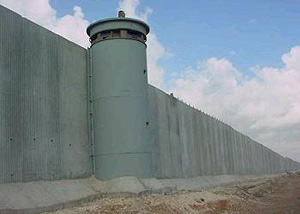 The fourth symptom of the last days is Israel's construction of the so- called "security barrier," a fortification extending for more than 700 km, including approximately 10% built as a wall ranging from 3 m to 8 m in height. The barrier prevents armed radical groups from entering Israeli territory (Fig. 1).
Even the prophet Ezekiel foresaw that this structure would be destroyed – but not by human beings. «And I will make a stormy wind break out in my wrath, and there shall be a deluge of rain in my anger, and great hailstones in wrath to make a full end. And I will break down the wall ... you shall perish in the midst of it» (Ezekiel 13:13–14).
Within the context of the author's reconstruction of future events, Ezekiel 13:10–15 is viewed not merely as a figurative exposure of false prophets, but also as an eschatological prophecy. The author allows for its literal fulfillment in the last days through the destruction of the modern Israeli "security barrier," not by human beings but by the forces of nature. This prediction belongs to those biblical prophecies that have a dual fulfillment: an initial historical fulfillment and a future eschatological one.
The fifth sign is given in the Apostle Paul's Second Epistle to the Thessalonians: «Let no one deceive you in any way. For that day will not come, unless the rebellion comes first, and the man of lawlessness is revealed, the son of destruction» (2 Thessalonians 2:3).
The sixth feature is the prophecy found in the Book of Joel: «The sun shall be turned to darkness, and the moon to blood, before the great and awesome day of the LORD comes» (Joel 2:31).
The seventh sign of the onset of the Great Tribulation is indicated in the Gospel of Matthew: «Then will appear in heaven the sign of the Son of Man, and then all the tribes of the earth will mourn ...» (Matthew 24:30).
2. Have All the Signs Been Fulfilled?
According to the Bible and its eschatological prophecies, the great and terrible Day of the LORD will come. Its nature has been examined in detail in the previous articles.
The question arises: "Could these signs have already been fulfilled?" in 1844, 1914, 1999, or 2000, as some predictors supposed. NO, not all seven biblical indicators have been fulfilled. Some have already become history, one is currently being fulfilled, while others are yet to come to pass. Let us examine them in greater detail.
The first sign (in the process of fulfillment). The Gospel of Christ's coming Kingdom on earth has already been proclaimed to the overwhelming majority of the inhabitants of our planet. Moreover, during the future first 3.5 years of the Tribulation period, this testimony will be heard by ALL nations.
The second sign (fulfilled). By a resolution of the United Nations General Assembly on November 29, 1947, the State of Israel was established, and on May 14, 1948, at 4:00 p.m., it was proclaimed in the building of the Tel Aviv Museum. Since then, Jews from more than 150 countries have returned from dispersion to their historical homeland.
The third characteristic (fulfilled). During the Six-Day War (June 5–10, 1967), the Israeli army established control over the entire territory of Jerusalem, which received a new status. On June 30, 1980, the Knesset declared the city the unified and indivisible capital of the state.
The fourth sign (fulfilled). The construction of Israel's “security barrier,” which began in 2004, has now been substantially completed.
The fifth prophecy (not fulfilled). Great indignation and a mass falling away (apostasy) from God have NOT yet reached their climax, nor has the son of destruction yet been revealed.
The sixth sign (not yet fulfilled). The prophet Joel speaks of the darkening of the sun and the moon, which the people of Israel will observe immediately BEFORE the coming of the Day of the LORD (Joel 3:4). Since solar and lunar darkenings are not unique astronomical phenomena, they should not be considered in isolation but in conjunction with other eschatological signs, especially those that immediately precede the Day of the LORD.
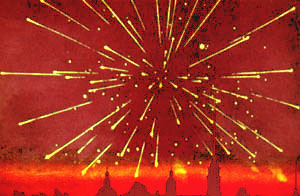
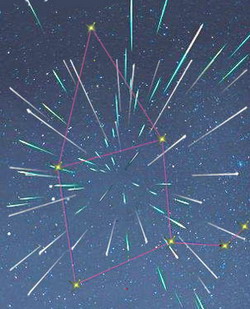
The seventh prediction (not fulfilled). The sign in heaven is directly related to the beginning of the Great Tribulation. The author associates it with a collision between our planet and a meteoroid-asteroid cloud, as well as with the appearance of the radiant of a meteor stream in the sky (Fig. 2). This interpretation is based on the reconstruction of events presented in the previous articles and will be further substantiated in the following sections.
The seventh sign (do not come true). This prediction of the sign (the sign) in the sky is actually the beginning of the Tribulation. Namely: a collision course with our planet's asteroid-meteor shower and the appearance of the sky the radiant of a meteor shower (2). This prophecy will come true if executed the previous (sixth) feature.
 This seventh sign will occur immediately after the sixth. Thus, of the seven key biblical signs, one is being fulfilled right now, three have already been completely fulfilled, and three remain in the future. The exact time when the first, fifth, and seventh signs will be fulfilled is unknown.
The first sign will probably be completed during the first half of the twenty-first century. The date of the appearance of the radiant (the seventh sign) can be calculated mathematically after the fulfillment of the fifth sign – the appearance of the son of destruction. According to the author's concept of future events presented in the previous articles, this will be a dwarf planet. A detailed biblical and natural-scientific justification for this interpretation will be presented in the following sections.
For determining the timing of the destruction of the degenerated civilization with greater precision, the sixth sign remains the key reference point – the prophecy of Joel concerning the eschatological solar and lunar darkening.
3. Eclipses and Their Consequences in the Old Testament
A solar eclipse occurs when the Moon passes between the Earth and the Sun, and a portion of the Earth's surface falls within its shadow. A lunar eclipse occurs when the Moon passes through the shadow cast by the Earth.
Total lunar eclipses may last up to 1 hour and 45 minutes, while total solar eclipses may last slightly more than 7.5 minutes, with a shadow width on the Earth's surface ranging from 100 km to 300 km. The shadow moves at a speed of approximately 1 km/s, covering a distance of up to 15,000 km. Between two and seven eclipses occur annually, of which no more than three are lunar eclipses.
Even in ancient times, the priests of Ancient Egypt and other nations carefully observed eclipses and compiled corresponding records. For many people of that era, these phenomena inspired fear and were often regarded as harbingers of future calamities.
Likewise, in the last days, as the prophet foresees, after the darkening of the heavenly lights, the Day of punishment, great and terrible, will come. «And I will show wonders in the heavens and on the earth, blood and fire and columns of smoke. The sun shall be turned to darkness, and the moon to blood, before the great and awesome day of the LORD comes» (Joel 2:30–31).
The future signs described by Joel may reasonably be considered (similarly to the case of the prophecy of Ezekiel 13:10–15) not only as symbolic images of God's judgment, but also as possible literal consequences of a coming natural catastrophe.
Then blood is the reddened waters of open reservoirs; fire is large-scale fires; and columns of smoke are aerosol plumes from burning forests. At the same time, similar signs would appear in the sky: a blood-red firmament and falling celestial bodies engulfed in flames, leaving columns of smoke behind them.
The prophet Amos also writes about such a dreadful day, before the onset of which the daylight luminary will grow dark: «And on that day,” declares the Lord GOD, "I will make the sun go down at noon and darken the earth in broad daylight» (Amos 8:9; in other translations: "darkness will descend upon the earth in the middle of the day"). In this same prophecy, a great shaking is described, during which the surface of the land rises and falls like the waves of the Nile River (Amos 8:8; 9:5).
Micah gives a similar prediction to that of Amos, but directed toward false prophets, seers, and diviners: «Therefore it shall be night to you, without vision, and darkness to you, without divination. The sun shall go down on the prophets, and the day shall be black over them» (Micah 3:6). In biblical language, such images of darkness frequently accompany descriptions of God's judgment, which in the subsequent text is specified as the destruction of Jerusalem (Micah 3:12).
4. Eclipses and Their Consequences in the New Testament
Jesus Christ warns of darkening as a sign of the end: «And there will be signs in sun and moon and stars, and on the earth distress of nations in perplexity because of the roaring of the sea and the waves» (Luke 21:25).
The carefree will be overcome with terror, and the wicked will lose heart from fear in the face of impending natural disasters and their consequences. For «There will be great earthquakes, and in various places famines and pestilences. And there will be terrors and great signs from heaven» (Luke 21:11). In the Gospel of Matthew, we read Christ's statement concerning the same events:
«the sun will be darkened, and the moon will not give its light» (Matthew 24:29a). Then «the powers of the heavens will be shaken (24:29с), as a result of which “the stars will fall from heaven» (24:29b) In modern astronomical understanding, it will not be literal stars that begin to fall, but meteoroid bodies entering the atmosphere.
«Then will appear in heaven the sign» (Matthew 24:30a). The author identifies the appearance of this "sign in heaven," at the sight of which «all the tribes of the earth will mourn» ( 24:30b), in connection with the formation of the radiant of a powerful meteor stream (Fig. 2).
The radiant will arise precisely as a result of the mass appearance of meteor bodies in the night sky. In the prophetic description, the darkening, the falling of the stars, and the appearance of the sign are presented as elements of a single chain of events. Therefore, it may be concluded that there is no significant interval of time between the darkening and the coming of the Day of the Lord (the Great Tribulation).
These future changes in the appearance of the heavenly lights (Fig. 3) were also seen by the Apostle John: «the sun became black as sackcloth, the full moon became like blood» (Revelation 6:12).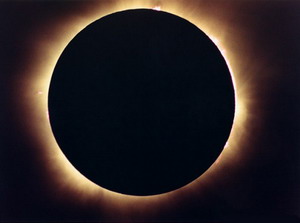
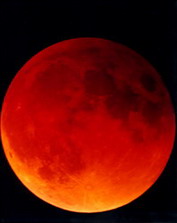 Why do John and Joel state that they saw the moon blood-red (Fig. 3b), rather than black like the sun (Fig. 3a)? Were the biblical prophets mistaken?
Absolutely NOT. During a lunar eclipse, sunlight passes tangentially through the Earth's atmosphere, where the short-wavelength blue portion of the spectrum is scattered most effectively.
In contrast, the long-wavelength red and yellow portions of the spectrum penetrate the atmosphere, reach the Moon, are reflected from its surface, and return to an observer on our planet.
That is why, during a lunar eclipse, our natural satellite may acquire a blood-red color similar to that described in the eschatological visions of Joel (Joel 2:31) and John («the full moon became like blood,» Revelation 6:12).
5. In What Season Will the Prophecies Be Fulfilled?
A number of biblical prophecies suggest that the time of the punishment of this world for its evil (the Day of the LORD) is associated with the spring season of the year. More precisely, with the modern month of April, when grain crops ripen in Palestine.
Thus, the prophet compares the judgment of the nations to the harvest of grain: «Put in the sickle, for the harvest is ripe. ... Multitudes, multitudes, in the valley of decision! For the day of the LORD is near in the valley of decision» (Joel 3:13–14).
Chapter 32 of Isaiah contains a prophecy that has not yet been fulfilled: «In little more than a year you will shudder, you complacent women; for the grape harvest fails, the fruit harvest will not come» (Isaiah 32:10).
This prediction refers to the beginning of the new ancient Hebrew year according to the Levitical sacred calendar. Specifically, it refers to the month of Aviv, the month of ears of grain (approximately corresponding to March/April in the modern calendar), later known as Nisan after the Babylonian captivity.
In those days, the prophet declares, there will be no grape harvest, nor will the barley or wheat harvest take place, for they will perish beforehand. For this reason, the seer calls out: «Be ashamed, O tillers of the soil; wail, O vinedressers, for the wheat and the barley, because the harvest of the field has perished» (Joel 1:11).
Hosea describes the atmospheric phenomena with remarkable precision, linking divine intervention with the dawn, the spring rain, and the east wind (Hosea 6:3; 13:15). He compares the coming of the Day of the LORD to the dawn (a reddened sky), to the spring rain that falls in Palestine at the end of March or the beginning of April, and to the hot east wind (one of its names is "khamsin"), which appears precisely in spring, predominantly in April.
Amos, in his vision of the locusts formed by God (Amos 7:1), mentions the spring growth after the king's mowings, while Isaiah compares people to grass that withers under the breath of El Shaddai (Isaiah 40:7), perhaps figuratively alluding to the effects of the scorching khamsin.
In the New Testament, the destruction of this generation is likewise compared to the spring harvest. All who practice lawlessness will be gathered like weeds in a field and burned with fire. In one of his revelations, John sees ALL the green grass burned up as a result of a censer filled with fire being cast down from heaven.
This event is preceded by astronomical signs: «And a great sign appeared in heaven: a woman clothed with the sun, with the moon under her feet, and on her head a crown of twelve stars» (Revelation 12:1).
Alongside the traditional theological interpretations, within the framework of the author's reconstruction this image also allows a cosmic interpretation. In that case, the woman clothed with the sun may be regarded as the Earth illuminated by the Sun, with the Moon beneath her and twelve stars above her. For John was in a special spiritual state (Revelation 1:10; 4:2; 17:3) that enabled him to behold these astronomical objects and even the New Jerusalem (21:10).
According to astronomical modeling performed by the author, a similar configuration of the Earth, the Moon, and the twelve most prominent stars forming the characteristic outline of the constellation Virgo is observed in spring. It occurs approximately between March 12 and April 18 when viewed from the direction of the constellation Pisces along the plane of the ecliptic. Within this model, there is a specific time (around April 3) when the Moon is positioned almost directly beneath the “feet” of the symbolic figure formed by the Earth and the stars of Virgo.
Jesus Christ proposes that the nearness of the end of this wicked generation should be discerned from the example of the fig tree putting forth its leaves. In Palestine, the fig tree produces leaves in early April. The first small green fruits (more precisely, fruit buds) indeed appear already at the end of March, before the leaves, but they quickly fall off in April. However, they do not fall off by themselves, but specifically because of the gusts of the spring hot dry wind.
Under the natural conditions of Palestine, the first immature fruits of the fig tree often fall as a result of strong spring winds (khamsin). It is precisely this well-known image that the Apostle John employs: «and the stars of the sky fell to the earth as the fig tree sheds its winter fruit when shaken by a gale» (Revelation 6:13).
In this vision, John compares the falling of the "stars" to the earth – which, in modern terms, may be understood as meteor bodies – with the dropping of immature figs in April.
6. The Last Passover
 One of the three festivals that God commanded His people to observe forever is Passover (Pesach) (Fig. 4). It is to be celebrated annually on the first full moon of the new year, on the evening of Nisan 14, which today most often falls in April.
Between sunset and the onset of darkness, the Jews prepared the sacrificial slaughter of the Passover lamb or young goat. They ate it during the night, inviting their neighbors to join the meal when necessary.
Remarkably, the prophet Zephaniah (1:7) employs the image of a sacrifice prepared by the LORD Himself, rather than by the inhabitants of Jerusalem, the priests in the Temple, or the heads of households outside the capital. Moreover, He has already appointed those whom He will summon on His Day, when all flesh will be silenced before Him.
«Be silent before the Lord GOD! For the day of the LORD is near; the LORD has prepared a sacrifice ...» (Zephaniah 1:7; more precisely, "sacrificial slaughter").
Within the framework of the author's reconstruction, this unusual image is viewed as echoing the Passover sacrifice and may point to an eschatological Passover of the last days.
Because of human sins, the sacrifice of total destruction will be ALL creation: the birds of the sky, the animals of the earth, the creatures of the seas, and the wicked themselves. The consequence of the Judgment will be the destruction of many nations and their rulers, figuratively portrayed as being gathered for «the great supper of God» (Revelation 19:17–21).
God conveys another promise to us through Zephaniah: «At that time I will search Jerusalem with lamps (in other translations: "the lamp"), and I will punish the men who are complacent ...» (Zephaniah 1:12a; literally: "sitting on their own yeast"), «zthose who say in their hearts, The Lord will not do good, nor will he do ill.» (1:12b).
Here the prophet recalls the traditional festive ceremony in which the head of a household searched the home for leaven or anything containing leaven. His allegory is clear and relevant: "Yes, we are disobedient to God because we remain settled in our sins, but He does not care!” No, not at all.
The Passover night will come, and then El Shaddai will reveal His unprecedented lamp, and not a single person will remain unnoticed. He will uncover the leaven of sin and destroy it.
The author believes that this powerful "lamp" may signify an extraordinarily bright celestial phenomenon associated with the appearance of the radiant of a meteor stream, which will become visible in the night sky.
Thus, in foreseeing the destruction of all living things on the Day of the LORD, Zephaniah connects it with Passover. If the other biblical prophecies are taken into account, the allegory of the search conducted with an unprecedented lamp acquires a quite realistic physical meaning.
On such a Passover night, a lunar eclipse will make the sky darker, making an external source of light necessary – provided that the prophecy of Zephaniah and the predictions of Joel (3:4), Amos (8:9), Micah (3:6), and John (Revelation 6:12) are indeed connected with a lunar eclipse.
In the New Testament, the apostles Peter and Paul indicate that Yom Adonai will begin at night. «But the day of the Lord will come like a thief, and then the heavens will pass away with a roar ... and the earth and the works that are done on it will be exposed» (2 Peter 3:10; in other translations: "will burn"). Paul says the same: «the day of the Lord will come like a thief in the night» (1 Thessalonians 5:2).
These statements of the apostles do not point to the suddenness of the coming of the Day of the LORD, but only to the fact that it will begin during the darkness of night, when thieves typically entered ancient dwellings. This conclusion is supported by the words of the prophet Amos: «Why would you have the day of the LORD? It is darkness, and not light» (Amos 5:18).
7. When Will the End Come?
Particular interest is presented by the year 2034, since the maximum phase of the eclipse for Jerusalem occurs approximately at midday, which is in better agreement with Amos's prophecy concerning the darkening of the sun at noon.
By contrast, the darkening of the daytime luminary in 2182 will NOT occur at noon. For Jerusalem, it will begin at 7:57 a.m., with the maximum phase occurring at 9:16 a.m.
In the spring of 2034, however, a solar eclipse will occur (March 20) under the following local conditions (for Jerusalem): maximum phase – 0.782; beginning at 11:40:34 a.m.; maximum phase at 13:03:53 p.m.; and ending at 14:22:25 p.m.
Fourteen days later, a lunar eclipse will occur (April 3) with a maximum phase of 0.878. It will begin at 18:51.8 p.m., reach its maximum phase at 21:06.8 p.m., and end at 23:21.7 p.m.
That same evening, on April 3 (Nisan 14), 2034, Passover will begin at sunset and with the appearance of three stars in the sky (approximately 18:00 p.m.). According to the author's calculations, it is precisely during this period of the lunar eclipse that the radiant of the Cepheus meteor stream may become visible. This radiant is regarded as a possible prototype of the heavenly sign mentioned in the prophecies (Fig. 5).
According to one widely accepted modern reconstruction, supported by a number of researchers, the crucifixion of Jesus Christ may have taken place on April 3, A.D. 33, on the eve of Passover.
The combination of astronomical eclipse calculations with the biblical calendar and the historical date of Christ's crucifixion creates a symbolic coincidence, in which the beginning of the New Testament era and the possible date of the end of modern civilization fall on the same calendar day – April 3.
8. The Most Important Seven-Year Period in History
The Book of Daniel speaks of the final seventieth week. Within this seven-year period, ALL the principal events relating to the "time of the end" will be concentrated.
The last seven years of the existence of this generation are commonly divided into two parts of 3.5 years each. The second half is often called by theologians the "Great Tribulation" or the "period of great tribulation."
If the reconstruction of future events presented above is correct, and the Great Tribulation begins in the spring of 2034, then the beginning of Daniel's final week will fall approximately in the autumn of 2030.
The author anticipates that by that time astronomers will discover a large meteor-asteroid stream that will be regarded as a potential threat to the Earth. As its trajectory is refined, the object's hazard level may rise to the highest values on the Torino Scale.
 The planetoid – also the stone, the beast, and the desolator of Daniel; the son of the dawn of Isaiah; the destroyer of nations and the burnt mountain of Jeremiah; the rider on a white horse, the dragon, and the beast of John; and the Leviathan of Job—will appear among the seven principal stars of the constellation Cepheus, as shown in the previous articles.
Within the framework of the author's reconstruction, all these biblical images are regarded as different descriptions of one and the same cosmic object. These descriptions are expressed in the allegorical and figurative language characteristic of ancient prophetic literature, which, naturally, could not operate with modern scientific concepts.
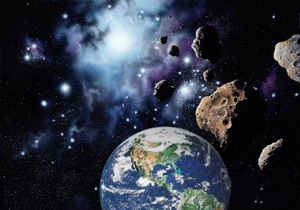
Astronomers will see the white horse in the north, near the horizon where the sky meets the earth; the destroyer of nations will receive the biblical name "Gog." It is with this object that the author identifies the biblical Gog from Ezekiel's prophecy. As the meteor-asteroid stream approaches the Earth (Fig. 6), society will be gripped by growing concern, which over time may develop into fear and widespread psychological tension.
If an official forecast declares a global collision to be unavoidable, a significant portion of the population may begin leaving large cities in search of safer regions. Upon seeing this, the words of Jesus Christ will come to mind: «then let those who are in Judea flee to the mountains» (Matthew 24:16). Then the solar eclipse of March 20, 2034, will occur.
9. Catastrophe
With the onset of the eclipse of the Moon (03/04/2034), at the sky more clearly be seen a meteor shower radiant Cepheus (Fig. 5) as proof of entry of the Earth flux of cosmic bodies, where it will stay about 2 weeks.
According to the author's calculations, the period of intense bombardment from space lasts approximately seven days, with the peak phase of Earth's passage through the cloud of meteoroid and asteroid bodies likely occurring around April 10, 2034. On that day, we will be under attack for ten hours by space bodies of various sizes. The largest among them will impact the region between the Arctic Ocean and the Atlantic Ocean, near Greenland.
The impact will trigger a «a great earthquake, such as never was since then, as people on earth» (Revelation 16:18). The global shaking and the resulting regional upheavals will destroy ALL cities and other settlements (as seen in the visions of John, verse 19; Jeremiah 4:26 and 9:11; Isaiah 17:9 and 25:2; Micah 3:12). The tremors will cause mountains to collapse, shift islands, and tear the ground open with wide, long fissures, massive sinkholes, and deep chasms.
Giant tsunamis and tele-tsunamis will arise along the world's continental shelves, penetrating hundreds or even thousands of kilometers inland and sweeping away everything in their path. Vast areas across many countries will be temporarily inundated by seawater for up to a year.
The largest impactor could have characteristics comparable to those of celestial bodies capable of causing global biospheric consequences—such as the Chicxulub asteroid. According to the author's estimates, the impactor would have an equivalent diameter of approximately 15 km and a mass of around 5 trillion tons. Its impact and the resulting seismic shocks would trigger cascading emergencies.
Geological events include large-scale landslides, rockfalls, talus collapses, lahars, debris flows, avalanches, and glacial surges. Meteorological events include hurricanes, typhoons, storms, tornadoes, squalls, and intense updrafts, as well as heavy hail, prolonged acid rain, and subsequent global drought.
Marine hydrological events include local fluctuations in global sea levels; tsunamis, teletsunamis, and megatsunamis; the rapid disintegration and drifting of polar ice; and shifts in ocean currents. Hydrological events include coastal inundation by seawater, flash floods, riverine flooding, waterlogging, and localized floods. Furthermore, there are large-scale forest and steppe fires.
Geophysical emergencies are also accompanied by intense volcanic activity, including eruptions of numerous volcanoes along tectonic plate boundaries and explosions of several of Earth's known supervolcanic systems.
Massive fires, fanned by hypercanes of unprecedented intensity, will engulf nearly the entire planet. The term "hypercane" refers to super-powerful hurricanes with wind speeds reaching up to 800 km/h – phenomena that, according to certain theoretical models, can arise following extremely powerful impacts. Driven by colossal atmospheric disturbances, a mighty, ferocious vortex will roll up the sky like a scroll – an image that echoes the biblical descriptions found in the writings of Isaiah and in the Revelation of John.
When the atmosphere begins to cool, continuous acid rains will fall in the dark for many days (about 40 days, like the flood in Noah's time), and they will end, according to the author's estimate, in June 2034. Then there will be a dark round-the-clock time, «neither day nor night» (Zechariah 14:7), lasting many months.
If we assume that the Great Tribulation will span the second half of Daniel’s seven-year period, then the phase of severe climatic instability could last approximately three and a half years. Thermodynamic equilibrium in the homosphere would then begin to partially recover only from November 2037, after which the long-awaited rains would finally return.
10. Who's to blame?
So, the question: "when the end comes?" We, with the help of the Bible, found the answer. The death of modern civilization will happen in the twenty-first century, in the last seven years, Daniel, in the second half in 2034 - 2037, respectively.
Then there is the traditional Russian question: "Who is to blame?". Because humanity would perish in nuclear fire, not a third world war, but as a result of cosmic catastrophe, does not mean that there are no culprits.
Vulgar materialist answer: "no one to blame! it is the work of blind chance. " Excuse me, but the case has no hands! In the world nothing happens by accident, because all events have a causal relationship, both visible and invisible.
The second possible answer: "God is guilty!". According to the Bible, He created our world and He will destroy it before humanity during the days of Noah. "Right, Who created, He has the right and destroy his creation. But there was good reason for the death of the previous race?
Was! In the book of Genesis we read: «The Lord saw that the wickedness of man was great in the earth, and that every intention of the thoughts of his heart was only evil continually (now the first. "About the evil they only of evil). And the Lord regretted that he had made man on the earth, and it grieved him to his heart» (Genesis 6:5-6).
Today, He too grieves in His heart, calling upon those spiritually dead through their transgressions to change their sinful lives and cease doing evil. Yet those who have lost the fear of God have stopped their ears to avoid hearing His words of rebuke, closed their eyes to avoid seeing their own vileness, and hidden behind the guise of tolerance to justify their indifference.
According to biblical eschatology, the judgment of the present generation is not the ultimate goal of God’s plan. It is to be followed by the restoration of life and the establishment of a new order based on God’s justice.
The ceaseless evil of modern madmen is directed not only against one another but also against the environment, aiming at the systematic destruction of a world not created by us. God will punish this: «but xyour wrath came, and ythe time... and afor destroying the destroyers of the earth» (Revelation 11:18).
Is, then, a universal, abstract evil to blame? No – not a general, abstract evil, but an individual, real one that dwells in the heart, the soul, and the mind. Thus, it is written for each of us to lament one's own sins (Lamentations 3:39), and proclaimed to all the ungodly that «So they are without excuse» (Romans 1:20).
From a biblical perspective, the problem lies NOT in the injustice of the Creator, but in the moral state of humanity itself. Scripture asserts that all people have sinned and continue to sin, and therefore need repentance rather than self-justification. That is precisely why the prophet Hosea declares: «There is no faithfulness or steadfast love, and no knowledge of God» (Hosea 4:1).
11. What should I do?
When asked "Who is to blame?" Usually follows the eternal question "what to do." This question is still asked Isaiah the prophet 2,700 years ago. «What will you do on bthe day of punishment, in the ruin that will come cfrom afar? To whom will you flee for help, and where will you leave your wealth?» (Isaiah 10:3).
Naturally, there will be all sorts of proposals – including some fantastic ones – on how to avert a cosmic catastrophe or even develop the country (perhaps involving a few failed attempts). However, it might prove impossible to prevent a collision between Earth and the meteor-asteroid stream by altering the trajectory of the central, planet-like body known as "Gog."
After all, the planetary defense methods known today might prove insufficient to avert a catastrophe. These include: radiation implosion (nuclear explosions), non-nuclear kinetic impactors, asteroid gravity tractors, ion cannons, focused solar energy, electromagnetic catapults, mounting a rocket engine on the surface of a minor planet, and so on.
It is logical to assume that the central object of the meteor-asteroid stream would be surrounded by a vast number of fragments of various sizes, making any attempt to intercept or deflect it extremely difficult. This is why the biblical prophet describes the Day of the LORD (Joel 2:31) as "great and awesome" (dreadful). No one can halt its approach; no one has the power to avert God’s judgment or to leave Earth to escape its consequences.
If a collision between Earth and a horde of cosmic invaders cannot be avoided, perhaps one should seek out safe havens – mountains, highlands, or plateaus – and take shelter there? Unfortunately, that would not be of much help. Another prophet asks a question that requires no answer: «But lwho can endure the day of his coming, and who can stand when he appears?» (Malachi 3:2).
John sees the aftermath of the tragedy (Chapter 6) and then sums it up: «for the great day of their wrath has come, and who can stand?» (Revelation 6:17; or more precisely, "survive it"). The answer that suggests itself is: "no one – absolutely no one."
Mass natural disasters and major man-made catastrophes will be global in scope, affecting our planet's atmosphere, hydrosphere, and geosphere. That is why the Lord declares: «And if those days had not been cut short, no human being would be saved» (Matthew 24:22, or "no living creature would survive").
According to the author's interpretation of biblical prophecies, the scale of casualties could reach a level where the vast majority of the Earth's population (up to 90%) perishes. Most of the fatalities would result not only from direct impacts but also from the secondary consequences of a global catastrophe – such as fires, tsunamis, earthquakes, atmospheric disturbances, famine, extreme cold, and epidemics – as described in biblical prophecies.
«I will utterly sweep away everything from the face of the earth,” declares the Lord. I will sweep away dman and beast; I will sweep away the birds of the heavens and dthe fish of the sea, and ethe rubble1 with the wicked. I will fcut off mankind from the face of the earth.» (Zephaniah 1:2-3).
John had already seen visions of the future mass destruction of the population caused by fire, smoke, sulfur, poisoned water, famine, epidemics, and wild beasts (Revelation 6:8, 8:11, 9:18). At the same time, numerous other biblical texts attest to the preservation of a remnant of people who will survive these tragic events; therefore, many interpreters view Zephaniah’s prophecy of total annihilation as a hyperbolic description of the scale of God’s judgment.
If the author’s reconstruction of future catastrophic events is correct, then the priority is not finding a technical means to avoid God’s judgment. What matters most is not a person’s physical survival, but their spiritual state and readiness to meet their Creator. That is precisely why the biblical prophets call, above all, for repentance, a turning to God, and a re-evaluation of one’s life.
12. How can one be saved?
The Bible contains a very important revelation from the Most High: «See now that hI, even I, am he, and there is no god beside me; iI kill and I make alive; jI wound and I heal; and there is none that can deliver out of my hand.» (Deuteronomy 32:39). According to this statement, the Creator of all things not only strikes and kills, but He alone can heal, restore life, and preserve – just as promised.
«Turn to me and be saved, hall the ends of the earth! For I am God, and there is no other.» (Isaiah 45:22). Yet, are there other ways to preserve life? NO. He insists, «I, I am the Lord, and besides me there is no savior» (Isaiah 43:11). But such statements – are they merely words written by a human being thousands of years ago? How can one believe them?
Those who want to make sure that such statements are not empty can read the Old Testament, and those who need strong evidence of healings and resurrections can take the New Testament into their hands. Whoever does not believe what is written, let him turn to the living testimonies of people freed from the shackles of sin. Miracles are impossible only if there is no faith in the Source of miracles.
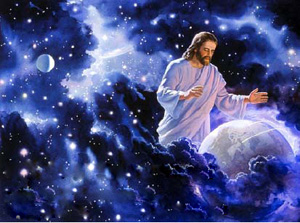
Without faith in the existence of the Creator, there is no sacrificial love; without it, freedom cannot be attained; and without freedom, there is no salvation, for we are slaves to sin. Yet, having said "yes" to God, one must learn to say "no" to temptations and sins. The Lord Jesus Christ (Fig. 7) is the One of whom the biblical prophets spoke repeatedly. It is He who liberates us from slavery to evil – the wages of which, according to the Law, is death.
 We may not like this stern Law at all, but it was established by the Creator of the universe and ordained for ALL—including Christ, who took upon Himself all our sins. Therefore, Jesus had to die, enduring crucifixion on the cross.
After the Crucifixion and Resurrection of the Lord, any person, under any circumstances, can escape death by accepting—with all their heart, soul, and understanding—His atoning sacrifice for their sins. For it is not indifferent tolerance in itself, nor the outward allure of wealth, that can save a person, but rather repentance and turning to God.
Therefore, to the question "What must I do?" there is one correct answer: «Believe in the Lord Jesus, and you will be saved, you yand your household.» (Acts 16:31).
Friend, in the days of Great Tribulation and global destruction – when many will die or be maimed – there exists a hope stronger even than death. To find it, you must turn to the Lord Jesus Christ right now, entrust your life to Him, and do His will rather than your own. «And it shall come to pass that ceveryone who calls upon the name of the Lord shall be saved.» (Acts 2:21).
The Lord can heal the wounded, the sick, and the infirm, and He will not forsake those who place their hope in Him, even in the face of death—for the ultimate victory over death is revealed in the Resurrection! Truly, «And there is asalvation bin no one else, for cthere is no other dname under heaven given among men3 by which we must be saved.» (Acts 4:12).
May God preserve you during the tragic times of trial looming over the whole world – trials meant to test this wicked and faithless generation. For biblical prophecies were given to humanity not to incite despair, but to inspire repentance, faith, and hope. Even the sternest warnings of Scripture are ultimately aimed not at a person's destruction, but at their salvation.